

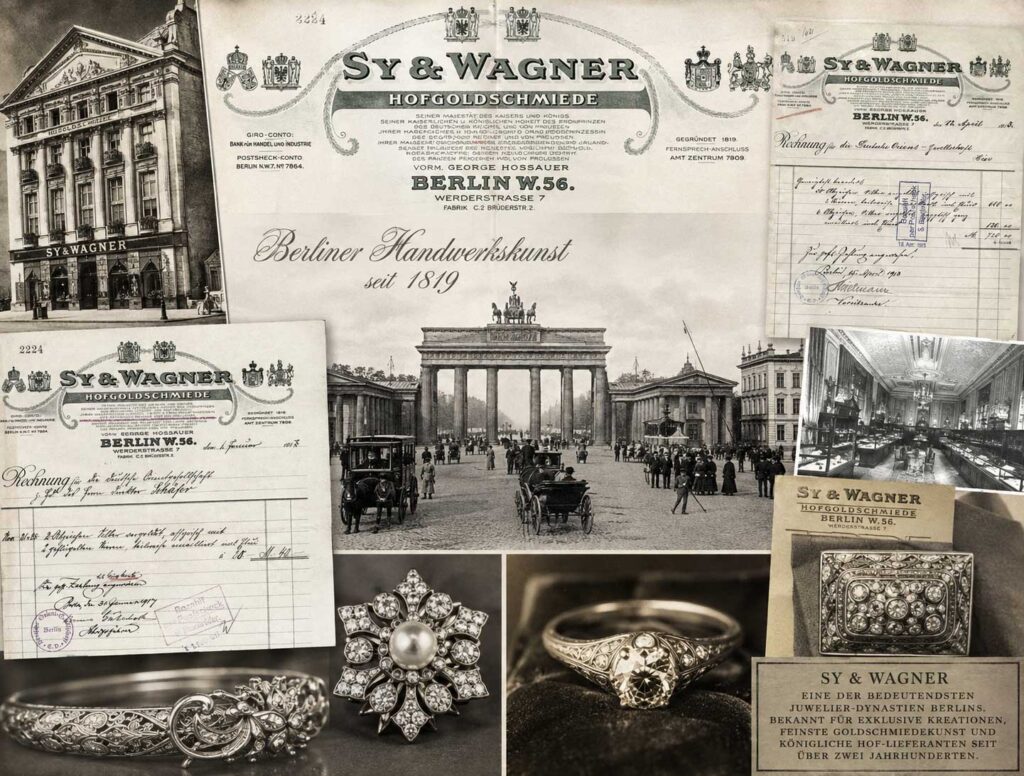
SY & WAGNER BERLIN – Court Jewellers from the German Empire to the City’s Downfall
Among the great names in Berlin’s historic goldsmithing tradition is a firm whose significance is now recognised almost exclusively by connoisseurs, museums and international collectors: Sy & Wagner Berlin.
In the 19th century, the Royal Prussian Court Goldsmiths were among the most prestigious manufacturers of jewellery, silverware, orders, decorations and precious ceremonial gifts in Germany. However, its history stretches further back than the actual company name, Sy & Wagner. It links two significant Berlin goldsmithing traditions: the Wagner family and the famous workshop of the royal court goldsmith Johann George Hossauer.
Sy & Wagner produced pieces for the Prussian royal family, the German imperial court, high-ranking military officers, state institutions, wealthy Berlin families and international clients. The works were created in the historic centre of Berlin, in the immediate vicinity of the palace, the street Unter den Linden and the government buildings of the Prussian capital. Today, the name Sy & Wagner can be found on precious silver objects, jewellery, orders, medals, cases and court honours. Many of these pieces are now housed in museums or prominent private collections, or feature in international art auctions.
The origins: Johann Wagner & Sohn in Berlin
The history of what would later become Sy & Wagner did not begin in 1859. One of its origins lies in the Berlin-based jewellery and goldsmith firm Johann Wagner & Sohn.
This firm was founded by the engraver and jeweller Johann Adam Wagner, who lived from 1761 to 1840. He was appointed court jeweller to the Prussian court as early as 1818. Two of his sons followed the family’s tradition of craftsmanship: Johann Carl Eduard Wagner and Carl Ludwig Wagner. Johann Carl Eduard Wagner continued to run the Berlin-based business. It was from this family that Emil August Albert Wagner, born in 1826, hailed; he would later become one of the two namesakes of Sy & Wagner. The Wagner family had thus been closely linked to the Prussian court and Berlin’s jewellery industry long before the founding of Sy & Wagner.
Albert Wagner was apprenticed to one of the most famous German goldsmiths of the 19th century: Johann George Hossauer.
Johann George Hossauer – Berlin’s ‘King of Goldsmiths’
Johann George Hossauer was born in Berlin in 1794. Following his apprenticeship in Paris, he founded a factory in 1819, with the support of the Prussian King Frederick William III, specialising in platinum, gold, silver, bronze and plated copper.
Hossauer combined the highest standards of craftsmanship with the latest techniques. His workshop developed into one of Europe’s leading manufacturers of gold and silverware. At times, the company employed up to 100 staff. Hossauer received numerous commissions from the Prussian court and worked, amongst other things, on designs by prominent Berlin architects and artists. His reputation was such that he was regarded as one of the most important German goldsmiths of his era. Between 1842 and 1846, Albert Wagner completed his goldsmith’s apprenticeship with Hossauer. This training proved decisive: Wagner learnt not only traditional goldsmithing techniques, but also how to organise a large, up to date silverware manufactory.
François Louis Jérémie Sy and Albert Wagner
The second person after whom the company was named was the merchant François Louis Jérémie Sy, often referred to as Louis or Jeremie Sy. He was born in 1827 and came from a long-established Berlin family with roots dating back to the French Reformation.
Contemporary genealogical records traced the Sy family back to Abraham Sy, who had emigrated to Prussia in the late 17th century. The family thus belonged to Berlin’s Huguenot-influenced population and not – as is occasionally hastily assumed – automatically to the Jewish community. François Louis Jérémie Sy contributed commercial and social connections to the joint venture. Albert Wagner represented the craftsmanship and creative tradition of the Wagner family of goldsmiths, as well as the technical expertise he had acquired at Hossauer. This combination of commercial management, courtly connections and highly skilled goldsmithing formed the basis for the subsequent success of Sy & Wagner.
When was Sy & Wagner founded?
Various dates are cited. Some auction catalogues name 1851 as the year of its foundation. However, the decisive takeover of the Hossauer workshop in 1859 is more reliably documented. Johann George Hossauer had no male heir to carry on his business. He therefore handed over his business in 1858/59 to his former pupil Albert Wagner and to François Louis Jérémie Sy.
Following this takeover, the company traded under the name Sy & Wagner. It was thus not merely a newly established jewellery firm, but the continuation of one of the most prestigious Royal Prussian goldsmith’s workshops. These origins explain the firm’s exceptional reputation. Sy & Wagner was able to draw on Hossauer’s tradition, workshop facilities, expertise and, in all likelihood, part of his client base.
Sy & Wagner on Kronenstraße in Berlin
One of the company’s early premises was at 28 Kronenstraße in Berlin. In a trade directory from 1866, Sy & Wagner appears under this address in the category of silverware factories and mints.
Kronenstraße was situated in what was then Berlin’s commercial and government district, between Friedrichstraße, Jerusalemer Straße and Hausvogteiplatz. Numerous goldsmiths, jewellers, textile firms and purveyors to the court had their business premises and workshops in this part of the city. The designation as a silverware factory and mint indicates that Sy & Wagner was considerably more than an ordinary retail shop. The company possessed the technical capabilities to produce larger silver objects, embossed medals, orders of merit and mass-produced decorations.
The court goldsmiths at 7 Werderstraße
Later, the address Werderstraße 7 in Berlin in particular became associated with Sy & Wagner.
Werderstraße was situated in the historic centre of the Prussian capital, close to the Friedrichswerder Church, the Berlin Palace, the Bauakademie and Hausvogteiplatz. It was one of the most prestigious locations in old Berlin. Historical Berlin guidebooks listed Sy & Wagner at Werderstraße 7 as a jeweller and goldsmith worthy of recommendation. A surviving case bears the inscription: ‘Court Goldsmiths, Berlin W., Werderstr. 7, Factory Brüderstraße 2’. This provides evidence of both the prestigious shop on Werderstraße and a production facility at Brüderstraße 2.
Brüderstraße was one of Berlin’s oldest streets and was situated on the Spree Island near the palace. The proximity of the sales premises, workshop, courtyard and government clients was of great importance to a company such as Sy & Wagner.
Albert Wagner becomes Prussian court jeweller
Albert Wagner was appointed court jeweller to the Prussian court as early as 1855. This honour was thus bestowed even before the official takeover of the Hossauer workshop.
The title of purveyor to the court was not merely a marketing designation. It attested to a special relationship of trust between the entrepreneur and the royal court. Holders of such a title were permitted to publicly display their connection to the court, thereby highlighting their social standing and the quality of their work. Sy & Wagner was later listed as the court goldsmiths to His Majesty the King. In a Berlin address book from 1887, Alfred Sy appears as the owner of the business at Werderstraße 7.
The death of François Louis Jérémie Sy and the next generation
François Louis Jérémie Sy died in 1881. The company was not dissolved following his death, but continued to be run within the family.
Alfred Sy, the son of Louis Sy, took on a central role. Contemporary sources describe him as a court goldsmith and long-standing co-owner of Sy & Wagner. The company name remained unchanged, even though the original founders had gradually left the business or passed away.
This was not unusual for jewellers with a long-standing tradition. The established company name represented considerable economic value. It guaranteed brand recognition and highlighted the long-standing connection to the Prussian court.
Jewellery and silverware by Sy & Wagner
Sy & Wagner’s range of products was exceptionally broad. The company produced not only medals but also sophisticated gold and silverwork for private and public clients.
Among their best-known works are: precious table centrepieces and ceremonial vessels, silver candlesticks and candelabra, cups, goblets and lidded mugs, bowls and trays, cutlery and tableware, gifts for presentation, jewellery and objets d’art, cases and containers, medals and commemorative tokens, orders and military decorations.
To this day international auction houses continue to document significant works by the firm. These include, for example, a pair of nine-branched silver candelabra dating from around 1870, as well as a monumental, partially gilded silver goblet from around 1889, which was created based on a design by Hugo Zacharias.
The surviving pieces demonstrate that Sy & Wagner were masters of both historicist forms and prestigious Neo-Renaissance and Neo-Baroque designs. Many objects were cast, hammered, chiselled, engraved, gilded or adorned with enamel and precious stones.
Commissions for prominent Berlin families
Sy & Wagner did not work exclusively for the court. Their clientele also included wealthy banking, business and middle-class families.
The Jewish Museum Berlin, for example, houses a silver christening set belonging to the Franz von Mendelssohn family, which was crafted by Sy & Wagner around 1889 or 1890. The inclusion of such an object in a museum collection highlights the firm’s standing within Berlin’s art and cultural history.
Particularly in the case of christening presents, wedding gifts, anniversary presents and prestigious table silver, Sy & Wagner combined personal sentimental value with masterful craftsmanship.
Courtly showpieces and state gifts
Among Sy & Wagner’s most spectacular creations were court ceremonial objects. One documented example is a field marshal’s baton made of platinum and gold, decorated with enamel, diamonds, rubies and pearls. The work is explicitly attributed to Sy & Wagner as Berlin court goldsmiths. Such works demanded far more than ordinary goldsmithing skills. They combined metalworking, gem-setting, the art of enamelling, engraving, knowledge of heraldry and absolute precision. Anyone who crafted a Field Marshal’s baton, an imperial gift or a high-ranking order of merit was directly contributing to the visible self-representation of the monarchy and the state.
Sy & Wagner as Jewellers to the Order
Today, Sy & Wagner is particularly well known amongst collectors of historical orders and decorations. The firm produced Prussian and German honours, including various orders and Iron Crosses. An Iron Cross 1st Class from 1914, preserved in the German Historical Museum, is attributed to Sy & Wagner as court and order jewellers. The piece was awarded in 1919 and is preserved with its case and box. The maker’s mark ‘S.W.’ is frequently associated with Sy & Wagner. In addition, there are marks written out in full, such as:
- ‘SY & WAGNER BERLIN’,
- ‘SY & WAGNER BERLIN 800’,
- ‘SY & WAGNER BERLIN 937’,
as well as corresponding silver and fineness hallmarks. However, when identifying historical medals, it is always necessary to check carefully whether a mark actually originates from Sy & Wagner. Similar initials were sometimes also used by other manufacturers.
Sy & Wagner during the First World War
During the First World War, the demand for medals, honours and military decorations rose sharply. Sy & Wagner was one of the Berlin-based companies that produced such items for government bodies and private recipients. Invoices also show that the company continued to produce handcrafted badges during the war years. As early as 1913, Sy & Wagner produced Babylonian-Assyrian and Egyptian badges for the German Oriental Society. A further invoice from 1917 documents the continuation of this work during the war. This demonstrates that Sy & Wagner by no means produced only military decorations on a mass scale. The company also continued to work for scientific, cultural and social organisations.
The end of the monarchy in 1918
With the abdication of Emperor Wilhelm II in November 1918, the title of ‘Court Goldsmith’ lost its official state function.
For companies such as Sy & Wagner, the end of the monarchy marked a profound turning point. The imperial court as a client disappeared, numerous noble families lost their financial resources, and demand for monumental ceremonial objects declined. Nevertheless, there is evidence that Sy & Wagner continued to operate. The firm continued to produce medals, commemorative tokens, silverware and jewellery during the Weimar Republic. Medals bearing the name Sy & Wagner were produced, for example, to mark the election of Paul von Hindenburg as Reich President.
Medals and honours from the 1920s and early 1930s that have survived also bear the company name Sy & Wagner. The brand name thus remained in use long after the First World War.
Sy & Wagner in the Weimar Republic
Economic conditions during the Weimar Republic were difficult for luxury goods companies. Inflation, currency reform, political unrest and, later, the Great Depression fundamentally transformed the market. The large court commissions of earlier decades were no longer relevant. At the same time, Berlin jewellers had to compete with modern department stores, industrial mass production and a changing consumer culture. Sy & Wagner, however, had several advantages: a name steeped in tradition, a connection to the Hossauer workshop, experience in the production of orders of merit, highly skilled goldsmiths and silversmiths and an extensive collection of models and historical designs. The company therefore remained in business until the early 1930s.
What happened to Sy & Wagner in 1933?
It is stated that Sy & Wagner existed until 1933. This can easily give the impression that the firm was closed down or expropriated following the National Socialists’ seizure of power. However, the available evidence paints a more nuanced picture. The company name Sy & Wagner was abandoned in 1933 and 1934 respectively as part of a corporate reorganisation. From 1934 onwards, the company appeared as part of Vereinigte Juweliere GmbH. A contemporary report in the *Deutsche Uhrmacher-Zeitung* documents a company with the name:
‘Vereinigte Juweliere G.m.b.H. Eugen Marcus, Sy & Wagner, H. J. Werner’.
Later, the name was apparently shortened or altered. Sy & Wagner was therefore not simply wound up without a trace. The business – or significant parts of it – was absorbed into a larger company in which several long-established jewellers’ names were brought together.
Was Sy & Wagner an ‘Aryanised’ company?
Based on the sources currently available to the public, there is insufficient evidence to support such a claim. The name Sy was of Huguenot origin. By 1933, the founders, François Louis Jérémie Sy and Albert Wagner, were long gone. Nor does the mere change of name in 1934 in itself prove that the firm was expropriated by the Nazis.
This does not mean that political or economic conditions after 1933 had no influence on the reorganisation. Nazi economic policy, the persecution of Jewish entrepreneurs and the increasing control of the precious metals trade transformed the entire industry.
However, a concrete statement regarding the ‘Aryanisation’ of Sy & Wagner could only be made with any credibility once commercial register records, lists of shareholders, asset documents and, where applicable, compensation files have been fully analysed. For a historically credible account, the following should therefore be stated:
The long-established company name Sy & Wagner disappeared in 1933/1934 as part of its incorporation into Vereinigte Juweliere GmbH. A direct, racially motivated expropriation of the company has not yet been proven beyond doubt.
What happened to the original owners?
Here, too, a clear chronological distinction is important. François Louis Jérémie Sy had already died in 1881. He could not, therefore, have been personally affected by the events after 1933. Albert Wagner belonged to the older generation of founders and was also no longer an active founder of the company by 1933. Alfred Sy, the son of François Louis Jérémie Sy, was a co-owner and court goldsmith for many years. A contemporary industry report describes him as a long-standing co-owner of Sy & Wagner. However, publicly available sources do not yet provide a reliable basis for describing him as a victim of Nazi persecution after 1933. The history after 1933 therefore primarily concerns the company, the brand name, the workshops and the legal successors, not the two original founders personally.
Vereinigte Juweliere GmbH
Vereinigte Juweliere GmbH apparently brought together several older Berlin-based companies or trade names. In addition to Sy & Wagner, the names mentioned in archival records include, amongst others, H. J. Werner, Janus & Friedrich and, at times, Eugen Marcus.
The Berlin State Archives contain files under titles such as ‘Deutsche Juweliere Sy & Wagner, J. H. Werner, Janus & Friedrich GmbH’. Furthermore, there is evidence of a later legal proceeding brought by Vereinigte Juweliere GmbH Sy and Wagner against the German Reich.
These archival records show that the company’s history did not come to a complete end after 1934. Rather, elements, rights or legal claims of the old firm lived on in later companies. However, the exact ownership structure of this company during the Nazi era cannot yet be fully reconstructed on the basis of publicly available sources.
Sy & Wagner during the Second World War
Like many Berlin-based companies, the successor company was also affected by the political and economic conditions of the Second World War.
Precious metals were subject to state control, civilian luxury goods production was restricted, and numerous businesses were converted to produce goods relevant to the war economy. Added to this were bomb damage and the destruction of large parts of Berlin’s historic city centre.
Werderstraße and Brüderstraße were situated in an area that was severely damaged during the Second World War and fundamentally altered after 1945. Today, only parts of Sy & Wagner’s historic surroundings remain. There is no definitive evidence that the company continued to operate under its old name during the war. By that time, the firm had already been absorbed into Vereinigte Juweliere GmbH.
Continuation after 1945
Of particular interest is a later case documented in the Berlin State Archives. It mentions a ‘Vereinigte Juweliere GmbH Sy und Wagner, I. H. Werner’ with an address in Rastede.
This suggests that legal or commercial aspects of the company continued to exist or were asserted outside Berlin after the war. Whether this involved an actual resumption of jewellery production, a purely legal succession, or the settlement of claims to assets and compensation cannot be conclusively determined without access to the relevant archive file.
One thing is certain, however: the history of Sy & Wagner did not end at a single, clearly datable moment. Although the famous name disappeared from Berlin’s business world in 1933/1934, its legal and economic legacy apparently extended into the post-war period.
How can one recognise original pieces by Sy & Wagner?
Original silverwork may bear the following markings, amongst others:
- ‘SY & WAGNER’,
- ‘SY & WAGNER BERLIN’,
- the initials “S.W.”,
- a fineness mark such as 800, 900, 937 or 990,
- a crescent moon and crown as the German silver hallmark, model or commission numbers, and occasionally the name of the designer responsible for the piece.
For some items, Sy & Wagner apparently collaborated with specialist silverware manufacturers such as Koch & Bergfeld. In such cases, a piece may bear both the Sy & Wagner mark and a manufacturer’s mark. The mark alone is not always sufficient for a definitive attribution. Style, workmanship, material, provenance and comparable items should also be examined.
Sy & Wagner on today’s art market
Works by Sy & Wagner regularly appear at German and international art auctions.
Particularly sought-after are: large silver candlesticks, historicist ceremonial vessels, imperial display pieces, jewellery of courtly provenance, rare orders and decorations, original cases, medals, and silver objects with personal dedications.
Prices depend heavily on rarity, condition, material, size, historical significance and provenance. An item with a verifiable connection to the Prussian royal family, the imperial court or a well-known figure usually possesses a significantly higher cultural-historical and economic value than an anonymous mass-produced item.
The art-historical legacy of Sy & Wagner
Sy & Wagner epitomises an era in which Berlin was one of the most important centres of European goldsmithing and jewellery art.
The company combined: the Wagners’ family tradition of craftsmanship, the technical and artistic legacy of Johann George Hossauer, the commercial acumen of the Sy family, close ties to the Prussian court, and the modern organisation of an efficient silverware manufactory.
Over many decades, Sy & Wagner shaped the image of courtly representation in Prussia and the German Empire. The workshop did not merely produce luxurious everyday objects; it created visible symbols of rank, remembrance, state authority and family tradition.
Sy & Wagner – a forgotten Berlin jeweller of world renown
Today, hardly anything remains of the former business premises on Werderstraße and the workshops on Brüderstraße. Even the company name disappeared more than 90 years ago. However, the works of Sy & Wagner have survived. They can be found in the German Historical Museum, the Jewish Museum Berlin, other public collections and in private hands around the world. The firm’s magnificent silver objects are sold at Sotheby’s, Christie’s, Bonhams and leading German auction houses.
Sy & Wagner is therefore one of Berlin’s most important forgotten jewellers. The history of the firm tells of the rise of the Prussian capital, of royal prestige, technical innovation and exceptional goldsmithing – but also of the end of the monarchy, economic crises, corporate mergers and the loss of a great traditional Berlin name.
Unlike in the case of Berlin jewellers that were demonstrably ‘Aryanised’, the demise of Sy & Wagner after 1933 cannot be portrayed as a direct Nazi expropriation without evidence. What is historically certain, above all, is its conversion or incorporation into the Vereinigte Juweliere GmbH from 1934 onwards. Thus, the history of Sy & Wagner does not end with a simple closure. Rather, it is lost in a complicated process of corporate succession, the final details of which still lie hidden in Berlin’s archive files.
Das könnte Ihnen auch gefallen

Welcome to the fascinating world of old jewelry! In the newly furnished shop of RHEINFRANK – Antique Jewellery you can buy antique jewelry from 3 centuries in a very relaxed atmosphere and let yourself be completely inspired. You can also view and purchase a representative and exciting part of our range in the large RHEINFRANK […]
Dear Customers, your team from Rheinfrank – Antique Jewellery wishes you all a happy and healthy new year! Together we hope for an exciting as well as harmonious year with perfectly set highlights – and if possible, many of them! We for our part in the last year we have looked very closely and listened […]
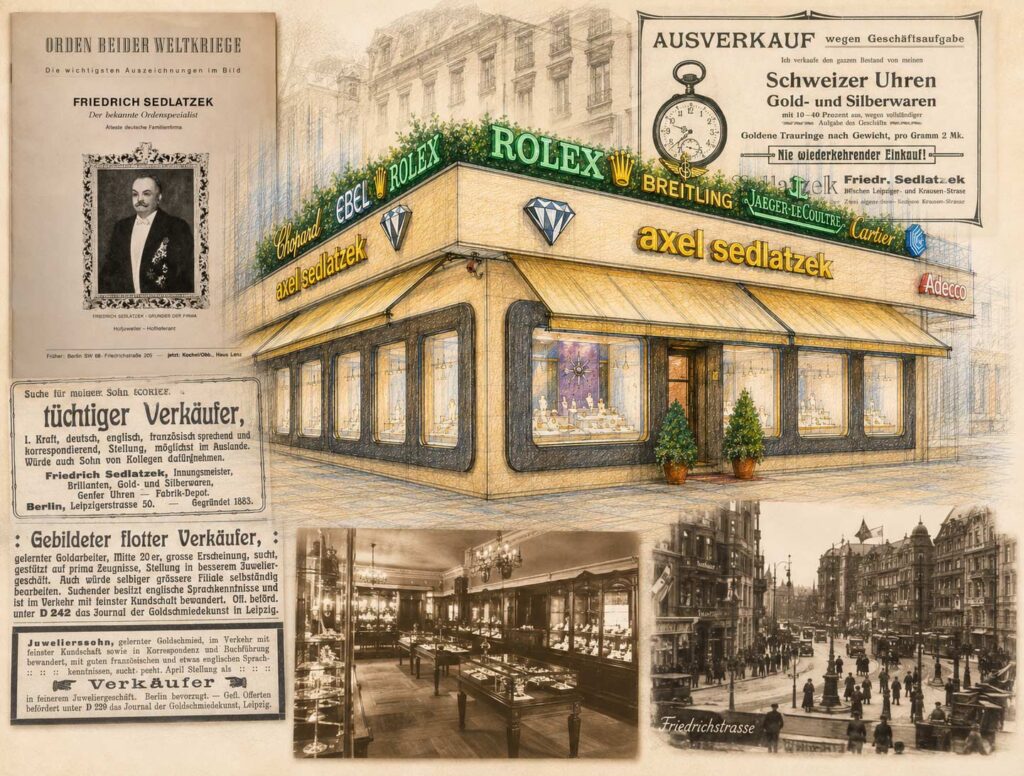
This is the moving story of the Sedlatzeks – a family of jewellers – from their beginnings as goldsmiths in Breslau to becoming Berlin’s last great jewelling dynasty Berlin has produced many great merchant families. Names such as Wertheim, Tietz and Kempinski are still well known today. Yet when it comes to the history of […]
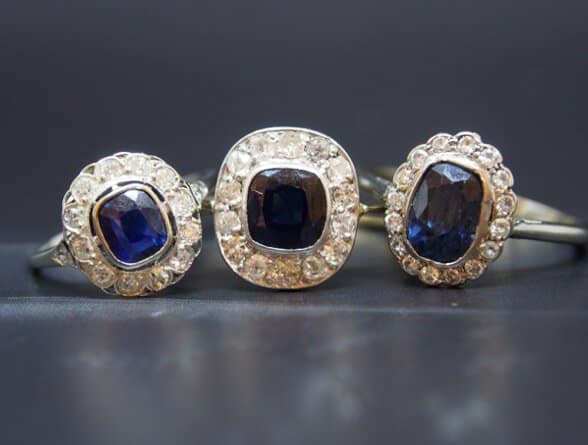
The sapphire is a perfect gemstone for engagement rings. His blue stands for loyalty, harmony and contentment. With this, important attributes for the romantic event are already ideally expressed with this color stone. Especially in the Edwardian period, beginning of the 20th century, sapphires were set as an eye-catcher in yellow and white gold rings. […]

A symbol of elegance and enduring Love Hardly any other piece of jewellery possesses the radiance of a solitaire ring. For centuries, it has symbolized love, trust, and the decision of two people to walk through life together. Today, it is regarded worldwide as the quintessential engagement ring. Yet the history of the solitaire ring […]

The pearls are back! Oh, were they ever gone? The big comeback of the pearl in jewellery design shows, how timeless and modern antique jewellery really is. Of course, every trend comes back someday – this is a wonderfully unplannable law in the fashion and lifestyle world. But why should you covet only the copies […]