


The Solitaire Ring – A Fascinating History of this Jewellery Classic from its origins to the present day
A symbol of elegance and enduring Love
Hardly any other piece of jewellery possesses the radiance of a solitaire ring. For centuries, it has symbolized love, trust, and the decision of two people to walk through life together. Today, it is regarded worldwide as the quintessential engagement ring. Yet the history of the solitaire ring began long before the famous storefronts on New York’s Fifth Avenue leapt aboard.
Rather, the solitaire ring is the result of centuries of development in European goldsmithing. Its history stretches from the workshops of the 18th century, through the great jewellers of the Belle Époque, to Charles Lewis Tiffany, whose revolutionary idea had a lasting impact on the modern engagement ring. When you look at an antique solitaire ring today, you are holding not just a diamond in your hands, but rather a piece of cultural history.
The Beginnings
The term “solitaire” is derived from the French word *solitaire*, meaning “alone” or “single.” It refers to a ring whose centrepiece consists exclusively of a single gemstone – traditionally a diamond.
The first solitaire rings were created in England and France as early as the Georgian era (1714–1837). At that time, diamonds were extremely rare and reserved exclusively for royalty, nobility and wealthy merchants. The gemstones were cut by hand and usually set in closed silver settings, while the ring bands were made of gold. This technique made the play of light appear much softer than with modern diamonds and gave each stone a warm radiance.
Even back then, a single diamond was considered an expression of esteem and devotion. The solitaire ring therefore quickly became a symbol of exclusive love and lasting fidelity.
The Victorian Era – The Solitaire Ring Takes on a Romantic Character
Queen Victoria’s accession to the throne in 1837 marked the beginning of one of the most significant eras in European jewellery history. Love, family, and personal emotions took centre stage in society – and this was reflected in jewellery design.
Goldsmiths crafted increasingly elegant solitaire rings with delicate settings and ornate embellishments. At the same time, new cutting techniques significantly enhanced the brilliance of diamonds. Historic old cuts, old mine cuts, and early cushion cuts gave each gemstone a distinctive character that differs markedly from modern brilliant-cut diamonds.
Many of these Victorian solitaire rings have survived to this day and are among the most sought-after historical engagement rings of all time
Charles Lewis Tiffany – The Man Who Revolutionized the Solitaire Ring
Although the solitaire ring had been around for many decades, today it is associated above all with one name: Charles Lewis Tiffany (1812–1902).
The founder of Tiffany & Co. opened a small store in New York in 1837 together with John B. Young. What began as a retail store for stationery and gift items evolved within a few decades into one of the world’s most prestigious jewellery houses.
Charles Lewis Tiffany recognised earlier than many of his contemporaries that the international diamond market was undergoing fundamental changes. Following the major diamond discoveries in South Africa beginning in 1867, large quantities of high-quality stones entered the world market for the first time. Tiffany was convinced that the focus of the piece of jewellery should no longer be the setting, but the diamond itself
The Year 1886 – The Birth of the Modern Engagement Ring
In 1886, Charles Lewis Tiffany introduced an invention that would forever change the history of jewellery – the famous Tiffany® Setting.
Until then, diamonds were usually set deep within closed or solid settings. The metal concealed a large portion of the gemstone and limited the amount of light that could enter it.
Tiffany, however, developed an elegant six-prong setting that allowed the diamond to float high above the band. For the first time, light could penetrate the stone from nearly every angle. The result was a brilliance previously unknown, which made the diamond itself the true centrepiece of the ring.
Charles Lewis Tiffany did not invent the solitaire ring but he did invent the modern solitaire ring as known by millions of people today. Hardly any other development has had a more lasting impact on the international jewellery market than this seemingly simple idea
The Solitaire Ring Conquers the World
Tiffany’s innovation spread throughout Europe and North America within just a few years. Major jewellers such as Cartier, Boucheron, Van Cleef & Arpels, and later Harry Winston developed their own interpretations of the solitaire ring, but all were guided by the basic principle of presenting the diamond as freely as possible and allowing light to flood through it.
During the Art Deco period of the 1920s and 1930s, particularly elegant solitaire rings were created in platinum, featuring geometric lines and the finest millegriffes. After World War II, the brilliant cut finally became the international standard, cementing the solitaire ring’s status as the world’s most popular engagement ring.
To this day, nearly all classic solitaire rings are based on the design principles developed by Charles Lewis Tiffany nearly 140 years ago.
Why Antique Solitaire Rings Are So Sought-After Today
When looking at an antique solitaire ring one soon realizes that historic pieces of jewellery are far more than precursors to modern designs.
Each ring was crafted entirely by hand. Goldsmiths sawed, filed, soldered, and set each diamond individually. Minor variations were not flaws, but rather an expression of true craftsmanship.
Added to this are historic diamond cuts such as the rose cut, old mine cut, or old cut. Unlike modern brilliant-cut diamonds, these stones were cut exclusively by hand. Their sparkle appears softer, deeper, and more unique. Many connoisseurs particularly appreciate this warm play of light, which differs significantly from the precise brilliance of modern diamonds.
Another aspect is becoming increasingly important today: sustainability. Each antique solitaire ring has existed for decades or even centuries. No new raw materials had to be extracted, and no new diamonds had to be mined. Historic jewellery therefore combines exceptional quality with the responsible use of existing resources.
History You Can Wear
Every antique solitaire ring tells its own story. It has accompanied people through happy times, weathered wars, generational changes, and societal shifts. Many of these rings have been passed down as family heirlooms and possess an authenticity that cannot be artificially created.
It is precisely this combination of history, individuality, and masterful craftsmanship that makes antique solitaire rings such coveted collector’s items and extraordinary engagement rings today.
Antique Solitaire Rings at Rheinfrank & Holzfuss in Berlin and Munich
Anyone who takes a close look at historical solitaire rings quickly realizes how differently each era approached their craftsmanship. For this reason, we at Rheinfrank place special emphasis on preserving the historical integrity of original pieces of jewellery. Our collection features one of the largest selections of antique solitaire rings and historic engagement rings in Germany – ranging from Georgian diamond rings and Victorian solitaire rings to extraordinary pieces from the Belle Époque and Art Deco periods. Nearly every ring can be professionally resized to your desired size in our own workshop by our experienced master jewellers. This preserves the ring’s historical authenticity while ensuring it can be passed down through many more generations.
Conclusion
The history of the solitaire ring began long before Tiffany & Co., but it was Charles Lewis Tiffany who, with his revolutionary six-prong setting, turned it into a global symbol of engagement. His idea permanently changed the history of jewellery and continues to influence nearly every classic diamond ring to this day.
Anyone who chooses an antique solitaire ring today is choosing not only extraordinary beauty, but also living history, enduring values, and the fine artistry of master goldsmiths of the past. Every historic solitaire ring is one of a kind – created in an era when jewellery was not mass-produced, but rather, crafted by hand with patience, experience, and passion.
That is precisely what gives it its unmistakable allure to this day.
You may also like

Founded in the heart of wild Berlin-Mitte, Rheinfrank – Antique Jewellery has become a trusted destination for authentic antique jewellery full of character and history. Owners Oliver Rheinfrank and Dirk Holzfuss have been advising clients from around the world for decades – with a sharp eye for beauty, craftsmanship, and originality. The roots of the […]
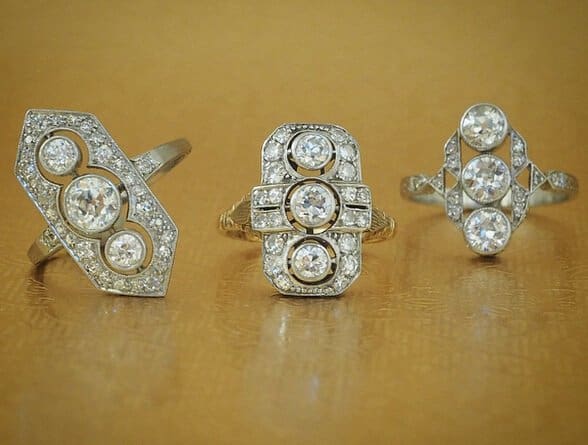
Dear Customers, your team from Rheinfrank – Antique Jewellery wishes you all a happy and healthy new year! Together we hope for an exciting as well as harmonious year with perfectly set highlights – and if possible, many of them! We for our part in the last year we have looked very closely and listened […]

The more technology behind the scenes – the more time for you! We’re a small business. And that’s exactly how we want to stay. Why? Because Rheinfrank – Antique Jewellery doesn’t thrive on anonymous structures, large administrative departments, or call centers. For us, it’s all about unique jewellery, personalized advice, and people who take time […]
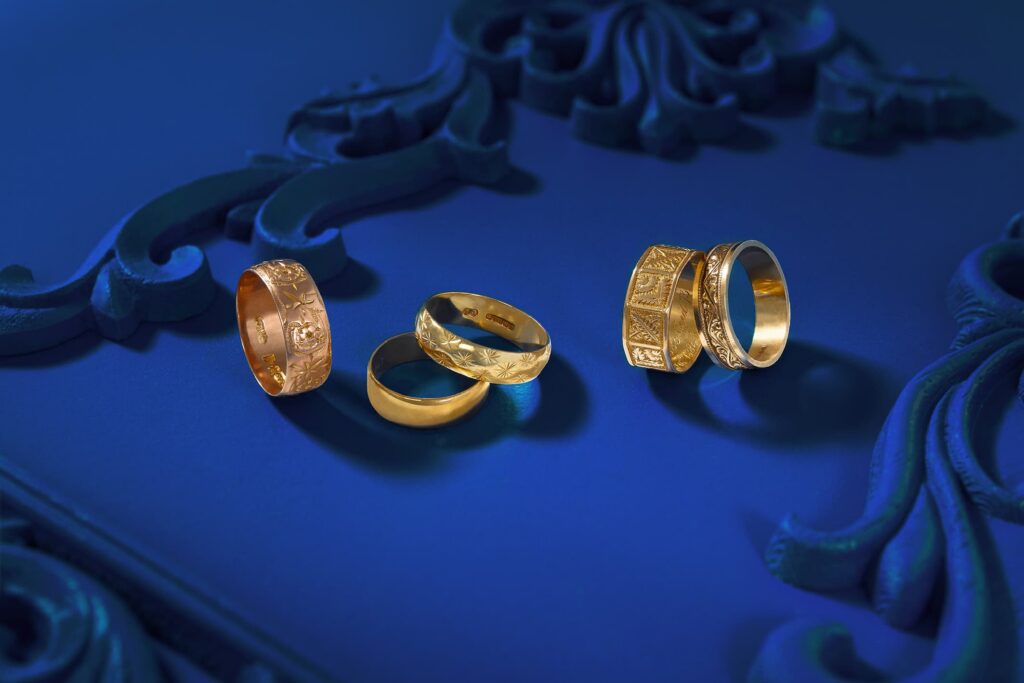
Since ancient times, the wedding ring has stood as a timeless symbol of love, unity, and eternity. In ancient Egypt, couples exchanged rings woven from reed or leather to mark their bond. The Romans were the first to craft rings from metal, representing strength and permanence. During the Middle Ages and the Renaissance, intricately engraved […]

If we assume the classic case of the man proposing to the woman and conjuring an engagement ring out of his trouser pocket, it seems clear to everyone that the ring is intended for the woman and that the next step is to put it on her finger. But is that always the case? When […]
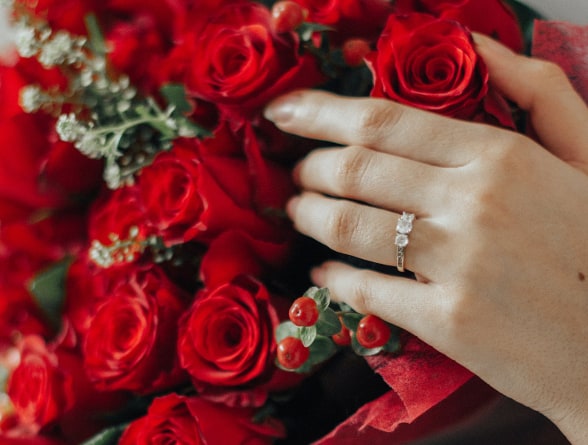
Let’s celebrate “Lovers’ Day” together. On February 14th every year our heart beats a little bit higher than usual. It is in the air – love breaks all boundaries! A happy couple in love is sure to show mutual affection at every opportunity. This creates a livable feeling of security and harmony. A perfectly natural […]