

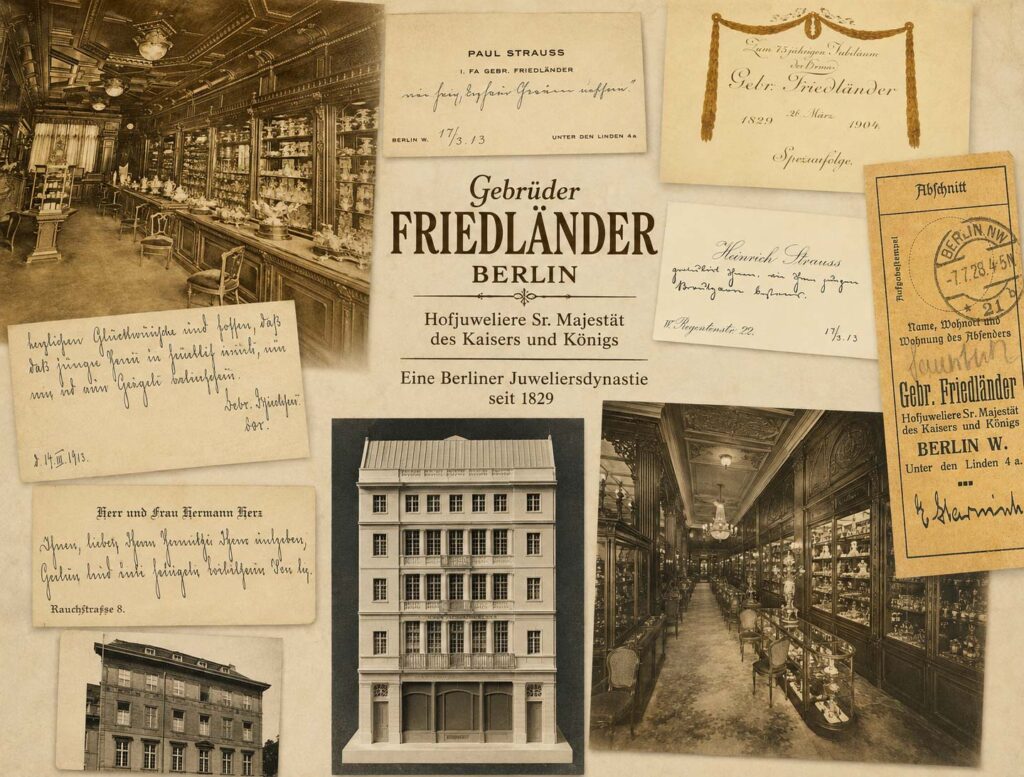
Friedländer Brothers, Berlin – Court Jewellers, Goldsmiths, and Silversmiths to the Imperial House
For more than a century, the Friedländer Brothers were among Berlin’s most prestigious jewellers, goldsmiths, and silversmiths. Their story began in 1829 on Berlin’s Schlossplatz and led the company all the way to the imperial court. Jewellry, silverware, medals, honorary gifts, and prestigious goldsmith works from the Friedländer workshop were crafted for the Prussian royal family, the German imperial court, the nobility, and the wealthy bourgeoisie.
Today, the Friedländer brothers’ creations exemplify the high quality of Berlin goldsmithing in the 19th and early 20th centuries. They combine artisanal precision with courtly elegance, precious materials, and a keen sense of the changing styles of their time—from Biedermeier and Historicism to Art Nouveau and the more functional design language of the 1920s.
Although the firm was once among the best-known names in Berlin’s luxury goods industry, its history is now familiar only to a handful of collectors of antique jewellery from Berlin, art historians, and connoisseurs of historic silver. The violent demise of the Jewish family business during the Nazi regime caused a significant name in Berlin’s jewellery history to virtually vanish from public memory.
The Founding of Saling & Friedländer in 1829
The origins of what would later become the firm Gebrüder Friedländer lie in the company Saling & Friedländer, which was founded in Berlin on March 30, 1829. Its first store was located at Schlossplatz 13, in the immediate vicinity of the Berlin Palace and thus in the political and social heart of the Prussian capital.
Among the founders were the merchant Zadig Levin Friedländer—whose first name is also recorded with alternative spellings—and his business partner Louis Saling. Just a few years after the company’s founding, in 1832, Saling withdrew from the joint venture. Zadig Levin Friedländer subsequently continued to run the jewellery and silverware business on his own.
The location on Schlossplatz was of great importance for a merchant specializing in precious goods. In the immediate vicinity were the royal palace, government offices, major banking houses, and the residences and business headquarters of wealthy Berlin families. The location provided access to a clientele that viewed jewellery, silverware, and prestigious gifts not only as personal treasures but also as visible symbols of social status.
The company flourished during a period when Berlin was evolving from a Prussian royal capital into a modern European metropolis. With industrialization, rising prosperity, and the social rise of the middle class, the market for high-quality jewellery, silverware, watches, medals, and luxury handcrafted items expanded.
Zadig Levin Friedländer – Founder of a Berlin Jewellery Dynasty
Zadig Levin Friedländer was born in Berlin in 1801. By founding his business, he laid the foundation for a company that would remain family-owned for several generations.
His business was not solely a retail operation. The company’s subsequent development shows that Friedländer was closely involved in the manufacture of gold and silver goods and increasingly maintained his own workshops and an extensive artisanal production operation.
In this way, the company followed the classic model of a leading 19th-century jewellery house: design, craftsmanship, sales, and consultation were closely intertwined. Larger commissions could be customized to meet the specific wishes of clients. At the same time, the firm offered a wide range of jewellery, silverware, and prestige items.
After Zadig Levin Friedländer’s death in 1861, management of the family business passed to the next generation. His son Siegmund Friedländer, in particular, played a decisive role in the firm’s further expansion. Under his leadership, the company entered its true heyday.
From a Jewellery Store to the German Emperor’s Court Jeweller
The Friedländer brothers’ economic rise coincided with a period of profound change. With the founding of the German Empire in 1871, Berlin became the imperial capital. The city grew at a rapid pace and developed into one of Europe’s most important political, economic, and cultural centres.
The imperial court, the numerous ministries, the diplomatic corps, the military, the new economic elite, and a wealthy upper middle class generated strong demand for luxurious and prestigious items. Jewellery and silverware were not merely personal possessions; they were given as gifts at weddings, anniversaries, state visits, military ceremonies, and social honours.
The Friedländer brothers knew how to establish themselves in this environment as one of Berlin’s leading jewellery houses. The company was awarded the title of Court Jeweller and crafted pieces for the Prussian royal family and the German imperial family.
The title of Court Supplier was far more than a mere honorific. It was regarded as visible proof of quality, reliability, and social standing. Companies that supplied the court had to be capable of producing particularly sophisticated custom pieces, fulfilling orders on time, and handling precious materials responsibly.
For a jewellery house, the connection to the court also served as an extraordinarily effective endorsement. Anything worn, used, or given as a gift at the imperial court also attracted considerable attention among the nobility, the military, the diplomatic corps, and the upper middle class.
Jewellery for Berlin, Prussia, and the Imperial Court
The Friedländer brothers’ production line included a wide range of handcrafted items. These included, among other things:
diamond and pearl jewellery, brooches, necklaces, bracelets, rings, earrings, cufflinks, shirt and collar buttons, tie pins, medallions, watches, medals, decorations, trophies, bowls, candlesticks, silverware, coffee and tea sets, as well as an extensive selection of table centrepieces and ceremonial vessels.
Such objects were crafted both for private use and as official gifts. Particularly high-quality pieces were often made of silver or gold and adorned with enamel, gemstones, natural pearls, monograms, coats of arms, or dedications.
One surviving example of court-commissioned work is a cross of the Royal Order of the Crown, crafted between 1872 and 1874. The piece, now housed in the German Historical Museum, is made of gold and enamel and is attributed to the court jewellers, the Friedländer brothers.
Other objects associated with Emperor Wilhelm I and Emperor Wilhelm II are also appearing today in museum collections and on the international art market. These include cutlery, platters, tableware, and ceremonial pieces, some of which bear imperial monograms or marks of ownership.
Berlin Silver by the Friedländer Brothers
A particularly important part of the company’s production was the Berlin silver crafted by the Friedländer brothers. The firm produced both small everyday objects and elaborately designed tableware and ceremonial pieces.
Surviving works demonstrate that the company had a firm command of various stylistic traditions. Some pieces draw on Baroque or Neoclassical models, while others feature elements of Historicism, Art Nouveau, or early Modernism. Traditional vessel forms were often combined with contemporary ornamentation.
Typical features of ceremonial silver from this era included sculpted handles, coats of arms, crowns, laurel branches, acanthus motifs, garlands, figurative representations, and elaborately modelled bases. For court commissions, symbols of sovereignty, monograms, or specific references to the occasion of the gift could also be incorporated.
The quality of these works explains why silver by the Friedländer brothers remains sought after to this day at auctions and in the specialized art market. The surviving pieces range from simple cutlery sets and small bowls to extensive coffee and tea services, table centrepieces, and extraordinary custom-made court pieces.
The Friedländer Brothers’ Workshops
The Friedländer Brothers were not only a retailer with a prestigious storefront but also operated a significant artisanal workshop. Historical exhibition records mention the company’s workshop in connection with sophisticated silverwork and official gifts.
Numerous specialized artisans worked together in such workshops. These could include goldsmiths, silversmiths, chasers, engravers, enamellers, gem setters, polishers, modelers, and draftsmen. Elaborate one-of-a-kind pieces were therefore often not the work of a single goldsmith, but rather the result of the coordinated collaboration of various specialists.
For large court commissions, external artists, architects, or sculptors might also be involved. The design of an object and its craftsmanship did not necessarily have to come from the same person. Thus, in the case of significant ceremonial pieces, a distinction was sometimes explicitly made between the design, modelling, and execution in the workshop.
It was precisely this combination of artistic design and highly specialized craftsmanship that made Berlin’s leading court jewellers internationally competitive.
Schlossplatz 15 – a jewellery store across the road from the palace
Throughout the company’s history, the store on Schlossplatz operated under various street numbers. In the later company chronicle, Schlossplatz 15 is listed as one of the company’s key locations.
Schlossplatz was one of Berlin’s most prestigious locations. The Berlin Palace served as the centre of the Prussian and later German monarchy. The surrounding area included the Lustgarten, Berlin Cathedral, Museum Island, and the main streets of the historic city center.
For a court jeweller, this location was ideal. Customers from the royal court, members of the nobility, officers, civil servants, diplomats, and wealthy visitors to Berlin could reach the store with ease.
The Friedländer brothers were thus closely connected to Berlin’s old centre of power—not only economically but also geographically. Their address became an integral part of the company’s identity.
Unter den Linden 4a – The Friedländer Brothers in the Heart of Berlin
In addition to their store on Schlossplatz, the Friedländer brothers later operated a prominent location at Unter den Linden 4a. The address also appeared in the commemorative publication marking the company’s centennial, published in 1929.
The boulevard Unter den Linden was one of Berlin’s most famous streets. It ran from the City Palace toward the Brandenburg Gate and was lined with palaces, hotels, banks, embassies, shops, and cultural institutions.
For a luxury retailer, an address on Unter den Linden meant maximum visibility and social prestige. This was where Berliners, international guests, diplomats, artists, members of the nobility, and business leaders gathered.
Historical photographs of the store convey the impression of spacious, elegantly furnished salesrooms. Jewellery and silverware were not presented like ordinary commercial goods, but rather in a prestigious setting that exuded trust, discretion, and exclusivity.
The Friedländer Brothers and Emperor Wilhelm II
Emperor Wilhelm II’s reign, from 1888 to 1918, was a period of particularly numerous prestigious commissions for the Berlin court jewellers. The German Empire cultivated a rich tradition of official gifts, orders of merit, anniversary presents, and military mementos.
Silverwork by the Friedländer Brothers was used for the imperial household and for gifts within the court circle. Preserved pieces bearing the monogram of Wilhelm II attest to the company’s close ties to the court’s culture of prestige.
However, the title “Jewellers to the Emperor” should not be understood to mean that a single company exclusively supplied the court. In addition to the Friedländer brothers, other prominent Berlin court jewellers and goldsmith firms also worked for the imperial family. Nevertheless, Friedländer undoubtedly belonged to the inner circle of prestigious Berlin firms entrusted with particularly demanding commissions.
The connection to the imperial court shaped the public perception of the firm. Its status as a purveyor to the court could be highlighted on invoices, advertisements, cases, and business stationery. For buyers, this served as a mark of quality that further enhanced the value of a piece of jewelry or silverware.
Royal weddings, anniversaries und honorary gifts
The 19th and early 20th centuries marked a golden age for ceremonial gifts. Cities, provinces, regiments, associations, companies, and private organizations honoured rulers and high-ranking dignitaries with precious gifts.
Such gifts had to convey their symbolic message at first glance. They might feature regional coats of arms, figures, allegorical depictions, historical scenes, or references to the recipient’s profession and rank. While material value was important, the individual design and the political or personal message conveyed by the object were equally crucial.
The Friedländer brothers’ workshops were particularly well-suited for such tasks. They possessed the craftsmanship to produce large silver objects, precious metalwork, and custom pieces set with gemstones based on complex designs.
In this way, the Friedländer brothers became key contributors to the imperial court’s and state’s culture of representation.
The Friedländer Brothers’ Stylistic World
Since the company was in business for more than a century, its body of work cannot be reduced to a single jewellery style. The Friedländer brothers adapted their designs to the tastes of different generations and clients.
Biedermeier and the Early 19th Century
In the company’s early years, clean, balanced forms, fine goldwork, and jewellery featuring coloured gemstones, pearls, or commemorative symbols were common. Jewellery was often closely tied to family events and was worn as engagement, wedding, mourning, or commemorative pieces.
Historicism and the Imperial Era
In the second half of the 19th century, Historicism drew upon forms from past eras. The Renaissance, Baroque, Rococo, Gothic, and Classicism were reinterpreted. The combination of different historical motifs was not a contradiction, but rather an expression of a deliberately representative design language.
Historicism offered court jewellers a wealth of possibilities. Crowns, coats of arms, eagles, laurel wreaths, cartouches, and other symbols of nobility could be effectively integrated into jewellery and silverwork.
Art Nouveau
Around the turn of the century, design styles began to change. Flowing lines, flowers, leaves, feminine profiles, and naturalistic motifs gained prominence. Asymmetrical compositions and a stronger emphasis on the overall artistic form also became fashionable.
Not every piece by the Friedländer brothers from this period is designed in a distinctly Art Nouveau style. A renowned court jeweller had to cater to both traditional and modern clients. As a result, conservative, historicist, and contemporary designs coexisted.
Art Deco and the 1920s
After World War I, jewellery and silverware often took on a more geometric and functional style. Clean lines, symmetrical shapes, and high-contrast combinations of materials characterized the international Art Deco movement.
Even a long-established firm like Gebrüder Friedländer had to adapt to these changes. The company remained active throughout the 1920s and was still able to celebrate its centennial in 1929.
Natural pearls, diamonds and precious stones
Historical jewellery by the Friedländer brothers was crafted from high-quality materials. Diamonds and natural pearls, in particular, played a significant role in the prestigious jewellery of the late 19th and early 20th centuries.
Before cultured pearls became widely available, genuine natural pearls were among the most precious organic materials used in jewellery. Pearls with uniform shapes and matching colours were rare and could command correspondingly high prices.
Small pieces of jewellery such as collar buttons, shirt buttons, brooches, or pins could therefore possess considerable material value despite their modest size. Particularly with men’s jewellery, luxury was often reflected not in striking dimensions, but in the quality of the stones, the precision of the setting, and the fact that the piece came from a prestigious jewellers.
Diamonds were cut into historical shapes depending on the period in which they were created. These included, among others, rose cuts and various precursors to the modern brilliant cut. The unique proportions of these stones define the distinctive character of antique jewellery.
Medals and Decorations from the House of Friedländer
In addition to jewellery and silverware, the Friedländer brothers also produced medals and decorations. This line of production was of particular importance to a court jeweller.
Orders were often made of gold or gold-plated silver and adorned with coloured enamel. Their production required extraordinary precision, as the shape, colours, inscriptions, and symbols had to conform to strict specifications.
An example of the Royal Order of the Crown, preserved at the German Historical Museum, documents the Friedländer brothers’ work in this field. Created between 1872 and 1874, this piece demonstrates that the company was already associated with official awards in the early years of the German Empire.
Today, correctly attributed orders and decorations are important historical sources. They link the art of goldsmithing with military, political, and social history.
The Hallmarks of the Friedländer Brothers
Original jewellery and silverware from the firm may bear various manufacturer’s marks and fineness marks. On silver objects, one often finds the company name written out in full or a corresponding Friedländer mark in conjunction with the purity or hallmark.
For German silver from the late 19th and early 20th centuries, purity marks such as 800, 835, or 925 are particularly common. In addition, the crescent moon and the imperial crown may appear as legally mandated German silver marks. However, older pieces may feature different marking systems.
A Friedländer signature alone does not replace a comprehensive art-historical examination. When attributing a piece, the shape of the mark, the fineness, any additional hallmarks, the craftsmanship, the stylistic features, and the provenance should always be considered together.
A distinction must also be made between a workshop mark, a sales mark, and the name of the goldsmith who crafted the piece. An item sold by Gebrüder Friedländer was not necessarily produced entirely in their own workshops. Conversely, pieces from the firm may bear additional hallmarks due to later alterations or repairs.
For collectors of Gebrüder Friedländer jewellery and historic Berlin silver, a careful examination is therefore essential.
The Company’s Centennial in 1929
In 1929, the Friedländer brothers celebrated their centennial. To mark the occasion, an elaborately designed private commemorative publication was issued, titled “Gebrüder Friedländer 1829–1929” or “100 Years of Gebr. Friedländer.”
The publication was dedicated to the company’s friends and patrons and was apparently not intended for general bookstores but was distributed only in limited quantities. It contained information about the company’s founding, its development, several generations of the family, and the production of gold and silverware.
The anniversary publication listed the Berlin addresses Schlossplatz 15 and Unter den Linden 4a. It thus documents the company’s close connection to two of the most prominent locations in Berlin’s historic city centre.
The anniversary, however, came at a difficult time. Germany was at the end of the so-called Golden Twenties. That same year, the Great Depression began, severely affecting trade, industry, and private wealth. Just four years later, the National Socialists seized power.
The Friedländer Brothers: A Jewish Family Business
The history of the Friedländer brothers is also a significant chapter in German-Jewish economic and cultural history.
Jewish entrepreneurs, merchants, goldsmiths, and jewellers played a vital role in Berlin’s rise to become an international commercial and cultural metropolis. They founded businesses, trained skilled workers, promoted the arts and sciences, and made a significant contribution to the city’s economic life.
The Friedländer Brothers, too, were closely connected to Berlin, Prussia, and Germany for generations. The fact that a Jewish family business supplied the Prussian royal court and the German emperor demonstrates how naturally Jewish entrepreneurs were involved in the social and economic development of the German Empire.
However, this historical connection did not protect the family from anti-Semitic exclusion, economic persecution, and expropriation after 1933.
Persecution After 1933
After the National Socialists seized power on January 30, 1933, conditions for Jewish businesses in Germany systematically deteriorated.
Boycotts, public defamation, official harassment, occupational bans, credit restrictions, and exclusion from economic organizations were used to drive Jewish business owners out of the business world. Customers were pressured to avoid Jewish businesses. At the same time, many companies lost their suppliers, orders, and access to financing.
The Nazi term “Aryanization” trivialized this process. In reality, it was a state-organized expropriation and the transfer of Jewish property to non-Jewish buyers. Sales often took place under duress, at prices far below the actual value, and under conditions that left the former owners with little room to manoeuvre.
The long-established Friedländer brothers were also affected by this.
The Forced Takeover in 1938
The Berlin database of Jewish businesses records a takeover of the firm Gebrüder Friedländer in 1938. The company’s new name is listed as Deutsche Goldschmiedekunst-Werkstätten, owned by Dr. Kurt Herrmann.
This marked the end of the more than 100-year history of the Jewish family-owned business Gebrüder Friedländer in its previous form.
Contemporary address book entries and later accounts list different street numbers and names. It is, however, a proven fact that during the Nazi era, the business was seized from its Jewish owners, taken over, and continued under a new, demonstratively “German” name.
This renaming was not a neutral business transaction. It was intended to erase the Friedländer family’s Jewish heritage and achievements from public consciousness, while allowing the business, inventory, workshops, customer relationships, and the reputation built up over generations to continue to be exploited for economic gain.
The expropriation of the Friedländer brothers thus serves as a prime example of the fate of numerous long-established Jewish businesses in Berlin.
What happened to the family after the loss of the company?
To properly understand the fate of the people behind the company, one must first distinguish between the historical company name “Gebrüder Friedländer” and the actual owner families as of 1938.
The last member of the Friedländer family who had been directly involved in managing the jewellery house was Felix Friedländer, a grandson of the company’s founder, Zadig Levin Friedländer. He died on September 30, 1914, at the age of only 45. His siblings had pursued different career paths: Ernst Friedländer became a banker, Max Julius Friedländer became one of the most internationally renowned art historians of his time, and Clara Amalie Friedländer married the lawyer Ernst Oppenheim.
After Felix Friedländer’s death, the company retained its time-honoured name. From then on, however, the company was run by the Herz and Strauß families, who were already closely connected to the Friedländer family through long-standing business partnerships and marriages. When the company was expropriated in 1938, Dr. Theodor Herz and Fritz Strauß—and their families—were the ones most severely affected financially.
The Herz Family
The Herz family was connected to the company through Hermann Herz. In 1894, Hermann Herz had married Else Friedländer, a daughter of the company’s former owner, Theodor Friedländer. In this way, the Friedländer and Herz families also became related by marriage.
After Hermann Herz’s death in 1923, his son Dr. Theodor Herz joined the company’s management. Together with Fritz Strauß, he represented the fourth generation of the company at its centennial celebration in 1929.
Else Herz, née Friedländer, did not live to see the company’s final expropriation. She died on March 20, 1936, in Berlin. Her daughter Nora Herz, born in 1906, was already in England at that time and was living in London. She later married Max Salomon and moved with him to Norway. She died in Oslo in 1999.
Nora’s brothers were also able to leave Germany—or Europe—in time. Günther Herz had already settled in New York in 1925. His brother Walter Herz had also been living in the United States since the late 1920s. Although their emigration took place before the Nazis came to power, it later spared them from immediate persecution in Germany.
The sources regarding the subsequent life of the company owner, Dr. Theodor Herz, are less clear. According to family history records known to date, he and his wife are said to have succeeded in leaving Germany. Buenos Aires, Argentina, is cited as the place of his later death. However, definitive archival evidence documenting all stages of his escape and his life in exile has not yet been made publicly available.
This uncertainty should be explicitly acknowledged. What is certain is that members of the Herz family left Germany and lost the life they had built in Berlin. Their flight meant not only the loss of their business, but also the abandonment of their homeland, their social standing, their possessions, and a family network built up over generations.
The Strauß Family
The Strauß family, too, had been involved with Gebrüder Friedländer since the late 19th century. Heinrich Strauß joined the company as a partner in 1896. He was later joined by his son Paul Strauß, who was regarded as an outstanding expert on gemstones.
After Paul Strauß’s untimely death in 1922, he was survived by his widow, Betty Strauß (née Pincsohn), and his sons Fritz and Heinrich. Fritz Strauß joined the company’s management and later ran the business together with Dr. Theodor Herz.
Historical Berlin address books show that the property at Unter den Linden 67—formerly Unter den Linden 4a—still belonged to the heirs of the Herz family and Betty Strauß in 1938. At that time, Betty Strauß was already living abroad.
Historical accounts report that members of the Herz and Strauß families were able to save their lives by fleeing. However, they were able to take only a portion of their possessions with them. Before their departure, Jewish emigrants were systematically plundered through the so-called Reich Emigration Tax, the Jewish Property Tax, foreign exchange regulations, and other state-imposed coercive measures.
Emigration was therefore neither a voluntary move nor an ordinary business decision. The families were expelled from Germany and were forced to abandon their economic livelihoods under the pressure of Nazi persecution.
Escape Rather Than a Voluntary Sale
Occasionally, it is claimed that Dr. Kurt Herrmann enabled the Jewish owners to leave the country by taking over the company. Even if personal contacts played a role in obtaining exit documents, this does not imply that the sale was voluntary or fair.
The transfer took place in 1938 under a regime that stripped Jewish entrepreneurs of their rights, economically isolated them, and forced them to relinquish their property. Those affected had no freedom to negotiate. The purchase price, the use of the money, and even the ability to take assets abroad were controlled by Nazi authorities.
In the Berlin database of Jewish-owned businesses, the entry is therefore correctly recorded as a takeover in 1938. As of November 2, 1938, the company was already listed under the name Deutsche Goldschmiedekunst-Werkstätten, owned by Dr. Kurt Herrmann.
The term “Aryanization” originates from the language of the perpetrators. It obscures the fact that this involved the forced displacement of Jewish owners and the appropriation of their businesses, their property, and their life’s economic work.
Deutsche Goldschmiedekunst-Werkstätten under Kurt Herrmann
Following the takeover, the business continued as Deutsche Goldschmiedekunst-Werkstätten under the leadership and ownership of Dr. Kurt Herrmann.
The new name alone is historically revealing. It replaced the widely known Jewish family name Friedländer with a company name that evoked national and artisanal connotations. This was intended to convey continuity in production while obscuring the actual expropriation of the former owners.
The story must therefore not be told as if Gebrüder Friedländer had merely been sold or renamed in the ordinary course of business. The change in ownership took place under the conditions of Nazi persecution of Jews and was part of the systematic exclusion of Jewish people from German economic life.
The name Friedländer disappeared—but the business continued to operate
The takeover involved more than just a transfer of ownership. The traditional Jewish family name also disappeared from the company. The Friedländer Brothers became the German Goldsmithing Workshops.
The new name gave the impression of a tradition-conscious, nationally oriented craft enterprise. In reality, its business premises, customer relationships, workshops, and economic reputation were based on more than a century of hard work by the Friedländer, Herz, and Strauß families.
The new owner, Dr. Kurt Herrmann, was a Prussian State Councillor and had connections to leading figures in the Nazi regime. In 1939, he was listed as both the owner of the property and the proprietor of the renamed company. The former Jewish owners had been forced to leave Berlin.
The Fate of Max J. Friedländer
Among the best-known members of the extended family was Max Julius Friedländer, the brother of the company’s last owner, Felix Friedländer. Although he did not work as a jeweller, he remained closely connected to the history of the firm and wrote the foreword to the 1929 anniversary publication.
Max J. Friedländer was an internationally recognized art historian and one of the foremost experts on Old Dutch painting. Because of his Jewish heritage, he, too, was increasingly marginalized after 1933. In 1939, he left Germany and moved to the Netherlands.
After the German occupation of the Netherlands, he once again found himself in danger. Despite his international renown, his survival was by no means assured. He remained in Amsterdam during the occupation and survived Nazi persecution. After the war, he was granted Dutch citizenship. He died in Amsterdam in 1958.
His life story illustrates that even members of a highly respected Berlin family, which had been connected to Prussian and German culture for generations, were driven out of Germany by the Nazis.
Restitution Following German Reunification
After World War II, the building on Unter den Linden was located in the Soviet sector of Berlin and later in the GDR. The assets that remained on the premises were not immediately returned to the former owner families.
It was not until after German reunification that the property at Unter den Linden 67 could be restituted to the heirs of the Herz and Strauß families. This allowed the descendants to recover a portion of their former property. However, the Friedländer Brothers company, which had been in business for more than a century, could not be restored. Its customer base, inventory, workshops, social standing, and family continuity were irretrievably lost.
The restitution of the property was therefore a belated legal acknowledgment of the injustice that had occurred—but not full redress.
Expulsion, Exile, and an Irretrievable Loss
According to current research, most members of the Herz and Strauß families managed to save their lives. However, they were expelled from Berlin and scattered across several countries and continents. England, the United States, Norway, and presumably Argentina became their new homes.
Behind the matter-of-fact statement “the family emigrated” lay the loss of their homeland, separation from relatives and friends, the abandonment of their professional life’s work, and a forced new beginning in foreign countries.
The Friedländer brothers did not simply disappear from the market due to economic changes. The company was taken from its Jewish owners under the conditions of Nazi persecution. The time-honoured name was erased, while the company’s material assets continued to be used by others.
The fact that family members were able to flee and survive does not diminish the injustice they suffered. Their story is inextricably linked to the history of the Friedländer brothers—just as are the magnificent pieces of jewellery, the imperial silverware, and the famous business premises on Unter den Linden.
What happened to the historic business premises?
The urban environment surrounding the historic Friedländer sites was profoundly altered by World War II and the subsequent redevelopment of central Berlin.
The old Berlin Palace was demolished in 1950 following severe war damage, by decision of the GDR leadership. Numerous historic buildings on Schlossplatz and along the eastern section of Unter den Linden were destroyed or disappeared during later renovations.
Today’s addresses and street layouts therefore cannot be easily compared to the situation in the 19th and early 20th centuries. Some historic house numbers were changed, lots were redrawn, and entire rows of buildings were demolished.
Nevertheless, anyone searching for traces of the Friedländer brothers in Berlin today will find themselves in the heart of the old city: between Schlossplatz, Museum Island, Unter den Linden, and the historic banking and business district of Berlin-Mitte.
The Friedländer Brothers Today—Sought After by Collectors and Museums
Original works by the Friedländer brothers can now be found in museums, private collections, and on the international art market.
Particularly sought after are:
signed pieces of jewelelry, diamond and pearl jewellery, court gifts, silverware bearing imperial monograms, extensive coffee and tea sets, cutlery, bowls, candlesticks, table centrepieces, goblets, medals, and pieces with verified provenance.
The value of an object depends on several factors. In addition to the material value, rarity, age, condition, design, quality of craftsmanship, historical significance, and provenance play a decisive role.
A comparatively small piece of jewellery can be particularly valuable from an art-historical perspective if it is clearly signed, comes from a significant commission, or can be attributed to a specific person. Conversely, a large silver object is not automatically rare if it was produced in large numbers or has been significantly altered.
For pieces from courtly or imperial collections, original cases, invoices, dedications, inventory numbers, and other provenance details significantly enhance their historical significance.
Why Jewellery by the Friedländer Brothers Is So Significant
Antique jewellery from the Friedländer Brothers is more than just a decorative object. It tells the story of Berlin’s development, the rise of the middle class, the courtly society of the German Empire, and the extraordinary quality of Berlin’s goldsmithing.
At the same time, every surviving piece serves as a reminder of a Jewish family of entrepreneurs whose achievements were systematically devalued after 1933 and whose business was expropriated in 1938.
This dual significance makes Friedländer jewellery particularly relevant today. It is both a work of art and a historical artifact.
A ring, a brooch, or a silver vessel can document both the aesthetic ideals of its era and the social conditions under which it was created. In the case of the Friedländer brothers, this historical context spans from the Prussian royal capital of the Biedermeier period through the German Empire and the Weimar Republic to Nazi persecution.
The Friedländer Brothers and Berlin’s Leading Court Jewellers
The Friedländer brothers stood alongside other prominent Berlin jewellers and goldsmith firms. These included, among others, Sy & Wagner, Paul Telge, Louis Werner, and other workshops that supplied the court, the military, government institutions, and Berlin’s wealthy society.
Nevertheless, Friedländer held a special position. Few Berlin jewellery houses could look back on a such a long and prestigious history. More than a hundred years elapsed between the company’s founding in 1829 and its forced takeover in 1938.
During this period, the company experienced five political eras: the Prussian monarchy before 1848, the period of German unification, the German Empire, the Weimar Republic, and finally the Nazi dictatorship. The history of the Friedländer brothers is therefore inextricably linked to the history of Berlin.
An Important Chapter in Berlin’s History of Jewellery
The Friedländer brothers were far more than mere sellers of precious items. They were among the businesses that made Berlin a major centre of European jewellery and silverware production.
Their workshops combined artistic designs with the highest quality craftsmanship. Their showrooms on Schlossplatz and Unter den Linden were located at the capital’s most prestigious addresses. Their clients came from the imperial family, the nobility, the military, the business community, and the upper middle class.
Through their jewellery, silverware, medals, and official gifts of honour, the Friedländer brothers contributed to the visual culture of Prussia and the German Empire. Their works were worn, used, given as gifts, and passed down through generations.
This makes the company’s demise all the more tragic. The forced takeover in 1938 not only destroyed a family’s economic livelihood; it also sought to erase their achievements from German history.
The Legacy of the Friedländer Brothers
Today, the name “Friedländer Brothers” lives on in the surviving pieces of jewellery, silverware, medals, historical photographs, invoices, cases, and company publications.
Every identified piece helps to reconstruct the history of this important Berlin jewellery house. This is not just about market values or famous clients. It is about preserving a cultural heritage that was torn apart by persecution, war, and decades of oblivion.
For collectors of antique jewellery from Berlin, for lovers of historic silver, and for anyone interested in the capital’s forgotten jewellers, the Friedländer Brothers are among the most important names of all.
The history of the firm from 1829 on Berlin’s Schlossplatz to the magnificent showrooms on Unter den Linden, the workshops of Berlin’s goldsmiths and silversmiths, and all the way to the court of the German emperors ended in 1938—not out of economic necessity, but as a result of Nazi persecution and the expropriation of a Jewish family-owned business.
The Friedländer brothers thus symbolize both the heyday and the loss of Berlin’s position within jewellery craftsmanship. Their work evokes a time when Berlin was one of Europe’s great centres for jewellery— they are a family whose name deserves to be brought back into and to remain in the spotlight.
Das könnte Ihnen auch gefallen

Founded in the heart of wild Berlin-Mitte, Rheinfrank – Antique Jewellery has become a trusted destination for authentic antique jewellery full of character and history. Owners Oliver Rheinfrank and Dirk Holzfuss have been advising clients from around the world for decades – with a sharp eye for beauty, craftsmanship, and originality. The roots of the […]
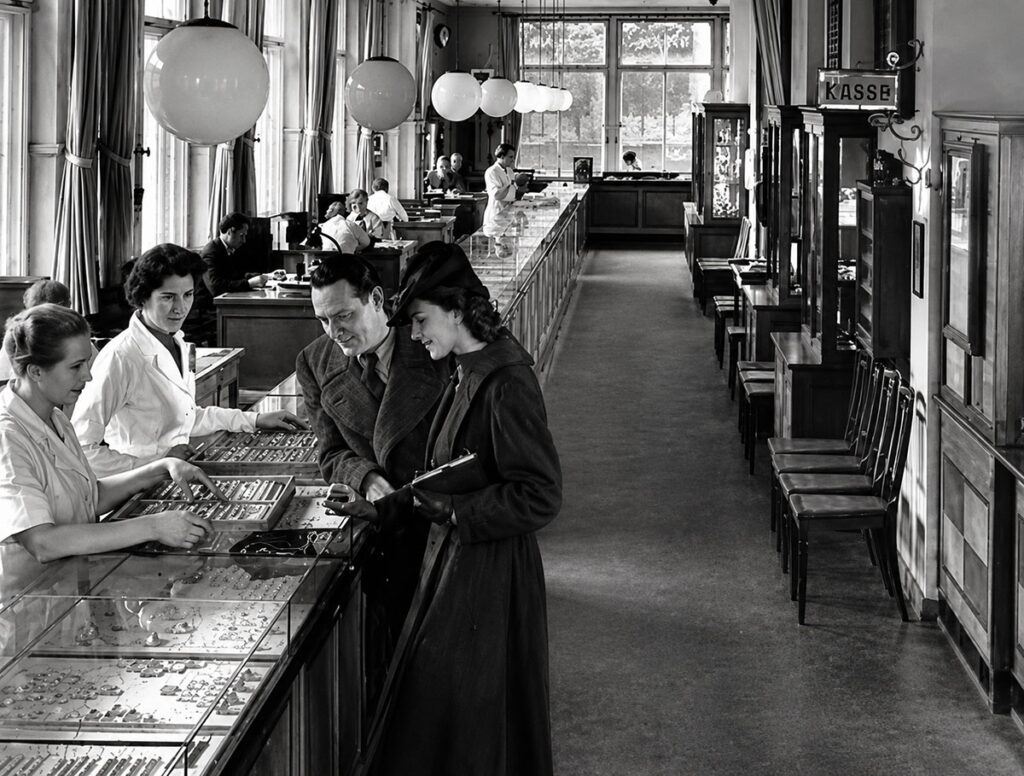
Anyone exploring the history of jewellery in Berlin will find it hard to overlook WILH. MÜLLER Berlin. For many decades, the company was one of the most prominent names in the German jewellery industry and was renowned far beyond the capital’s borders for its high-quality jewellery collections. To this day, collectors, antique dealers and lovers […]
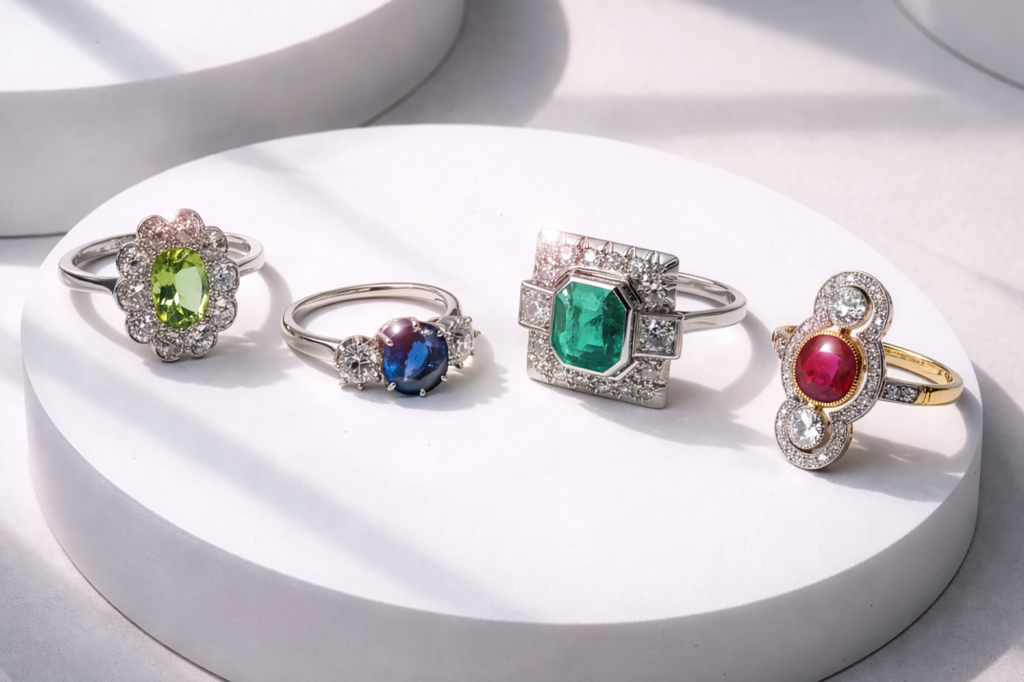
Historic and uniquely crafted antique rings are a perfect mirror for the couple embarking on life together. Of lasting value, antique engagement rings are the sought-after, exclusive alternative to today’s mass produced designs. At Rheinfrank & Holzfuss, with our elegant showrooms in Berlin and Munich, clients will find Europe’s largest selection of antique engagement rings — […]

Antique jewellery is much more than only beautiful. It is a passionate attitude to life! Antique jewellery transports everything that today’s society longs for: timelessness, sustainability and individuality. The pleasant feeling of something nostalgic, that everyone likes to feel, mates with the amazing insight, that everything that is praised today as individual and innovative, ultimately […]
Currently we experience the romantic Renaissance of the engagement ring. This development is especially for young people the climax on reflecting the honest and remaining values in life. Even more: it is a unprecedented declaration of love to love. An antique engagement ring corresponds to the today’s desire for individuality and esteem the most. Pieces […]

Welcome to the unique world of Antique Jewellery Berlin! Willkommen in Berlin! Bienvenidos amigos! We are very happy to offer our website and online shop in three languages now. The world of antique jewellery enthusiasts is moving closer together again. Besides our mother tongue German, and the indispensable English, Spanish is a wonderful language for […]