

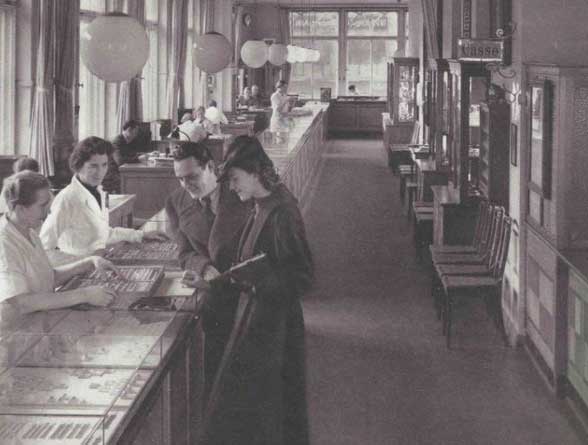
WILH. MÜLLER Berlin – A jewellery house that shaped the history of jewellery in Berlin
Anyone exploring the history of jewellery in Berlin will find it hard to overlook WILH. MÜLLER Berlin. For many decades, the company was one of the most prominent names in the German jewellery industry and was renowned far beyond the capital’s borders for its high-quality jewellery collections. To this day, collectors, antique dealers and lovers of historical jewellery come across the distinctive hallmarks and cases of this long-established Berlin firm.
The story begins in 1847, when Friedrich Wilhelm Müller founded a specialist wholesale business in Berlin dealing in gemstones, pearls and gold, silver and bejewelled jewellery. The company’s headquarters were located on Gertraudenstraße, in the historic heart of Berlin – just a few steps from Spittelmarkt. In the second half of the 19th century, this neighbourhood developed into one of the capital’s most important commercial centres. A vibrant network emerged amongst goldsmiths, gemstone dealers and jewellers, making Berlin one of the leading jewellery hubs of the German Empire.
As Berlin’s economy flourished, so too did WILH. MÜLLER. The company combined commercial acumen with a keen sense of the prevailing tastes. During the Historicism period, elegant pieces of jewellery were created with echoes of the Renaissance, Baroque and Rococo styles. At the turn of the century, Art Nouveau followed, with its flowing lines, floral ornamentation and a lightness that remains fascinating to this day. In the 1920s, geometric shapes and clean-cut elegance finally came to reflect the spirit of Art Deco.
Like so many long-established Berlin-based companies, WILH. MÜLLER was not spared the political upheavals of the 20th century. The Second World War and the division of Berlin fundamentally altered the economic landscape. The company initially relocated its headquarters from the historic Gertraudenstraße to Pforzheim, the centre of the German jewellery industry. At the same time, a branch was established in Schwäbisch Gmünd, another town with a long tradition of gold and silver craftsmanship. After both Berlin and Pforzheim had suffered considerable war damage, production was permanently concentrated in Schwäbisch Gmünd – initially with the numerous experienced staff from Berlin.
Although the name WILH. MÜLLER is no longer immediately associated with Berlin today, its roots are inextricably linked to the capital. The company is a prime example of those Berlin jewellery houses whose history is closely interwoven with the city’s economic, cultural and social development. The jewellery pieces tell not only of changing fashions and artisanal perfection, but also of the profound changes that Berlin has undergone over the course of almost two centuries.
At RHEINFRANK – ANTIQUE JEWELLERY, we frequently come across pieces by WILH. MÜLLER Berlin. They take us back to a time when Berlin was one of the most important centres of European jewellery art, and when goldsmiths, jewellers and gemstone dealers played a key role in shaping the city’s international reputation. Every piece of jewellery that has survived is therefore far more than just a beautiful object – it is a small piece of Berlin’s cultural history.
Das könnte Ihnen auch gefallen

Dear customers, we are here at your side. Life goes on, even if in the current situation we have to accept some restrictions in our freedom of movement. We always see beauty in the little things. That is our job – and we love it! Even if meeting family and friends is difficult at the […]

New Year – new luck! We are very lucky to be able to take the word “luck” literally. We are surrounded by it because we are here to just make people happy with beautiful antique jewellery. The past year was indescribable – it was an emotional and business success. We would like to say THANKS […]
Let’s celebrate “Lovers’ Day” together. On February 14th every year our heart beats a little bit higher than usual. It is in the air – love breaks all boundaries! A happy couple in love is sure to show mutual affection at every opportunity. This creates a livable feeling of security and harmony. A perfectly natural […]
The engagement as a ceremony, whether large or small, is of course not as old as love itself. Historically, since antiquity, the man has been cultivating the custom of permanently bonding to a wife / partner through engagement. For centuries, the act of engagement has given the beloved one a binding promise to marry him […]

We’ve said a lot of things about engagement rings. This is only logical, because we are the specialists for antique jewellery in Berlin and the first contact point for truly individual engagement rings. For more than 20 years we have been gathering experience from which every person willing to get engaged can benefit. More than […]
Valentine’s Day is actually easy to plan. Like Christmas and New Year, he falls on the same day every year: the 14th of February. Thanks to Saint Valentine, this is the day of all lovers in the world. Romantically inclined people, to whom most of us probably want to be counted, plan to spend a […]