

Gruschow – A Jeweller from Old West Berlin
The story of an near forgotten family of jewellers on Kurfürstendamm
Amid the big names of the international luxury brands along Berlin’s Kurfürstendamm, there were also, for decades, those shops that won the trust of a loyal clientele through their artisanal expertise. Among these establishments stood Gruschow Jewellers. The store at Kurfürstendamm 25 in Berlin-Charlottenburg was one of those classic West Berlin establishments that brought together jewellery, watches, silverware, precious stones, and diamonds under one roof. Even today, the name is listed in business directories with this address. Unlike Sedlatzek, Sy & Wagner, or the Friedländer brothers, Gruschow’s verifiable history in Berlin does not begin during the German Empire. Rather, the key clues point to the early years of the Federal Republic and the period of West Berlin’s reconstruction.
The trail begins in Poland
At the centre of this family history is the jeweller Leo Gruschow. A historical record lists his date of birth as December 20, 1922, and his country of birth as Poland. It explicitly lists his occupation as “jeweller” and names his parents as Emil Abraham Schmuel Gruschow and Freida Jachimowicz. According to this source, Leo Gruschow died in Berlin in 2012. The evidence suggests that the family came to Berlin from Eastern Europe and built a new economic life here after World War II. This would make the Gruschow family’s story a typical postwar Berlin story: the story of a family that left its homeland or former way of life behind and started over in the devastated, divided city.
Emil Gruschow and the Amberte Watch Brand
The earliest business reference shows up in 1954. On August 6, 1954, the “Amberte” trademark for watches and watch parts was registered under Emil Gruschow in Berlin. This registration shows that Gruschow was not merely active as a retailer but also, at least at times, sold watches under his own brand name. Preserved Amberte watches confirm that this was not merely an unused trademark application. Collectors are familiar with wristwatches bearing the name Amberte that are explicitly associated with the Berlin-based company Emil Gruschow. One documented example was given as a confirmation gift as early as 1958. This was by no means unusual for the 1950s. Many German jewellers and watch wholesalers sourced movements and cases from specialized manufacturers, had them assembled according to their own specifications and then sold them under their own brand. The name on the dial therefore did not necessarily refer to a watch factory of its own, but often to the retailer or the client.
For Gruschow, however, the Amberte brand is of great significance. It shows that the family was already firmly established in the Berlin watch trade just a few years after the war and had the ambition to enter the market under its own name.
Emil and Leo Gruschow—Two Generations in Berlin’s Jewellery Trade
Genealogical records list Emil Gruschow as the father of jeweller Leo Gruschow. Taken together with the 1954 trademark registration, this paints a coherent picture: Emil Gruschow likely laid the business foundation upon which Leo Gruschow later built the jewellery business. When the first retail store was opened and at which Berlin address the family operated before moving to Kurfürstendamm cannot yet be reliably determined from publicly available sources. It also remains unclear whether Emil and Leo Gruschow initially worked together in the watch trade or whether Leo took over an existing business later on and expanded it to include jewellery, gemstones, and high-quality gold goods. One thing is certain, however: the watch business, documented in the 1950s, evolved into a classic Berlin jewellery store that maintained its reputation for several decades.
Kurfürstendamm as a New Home
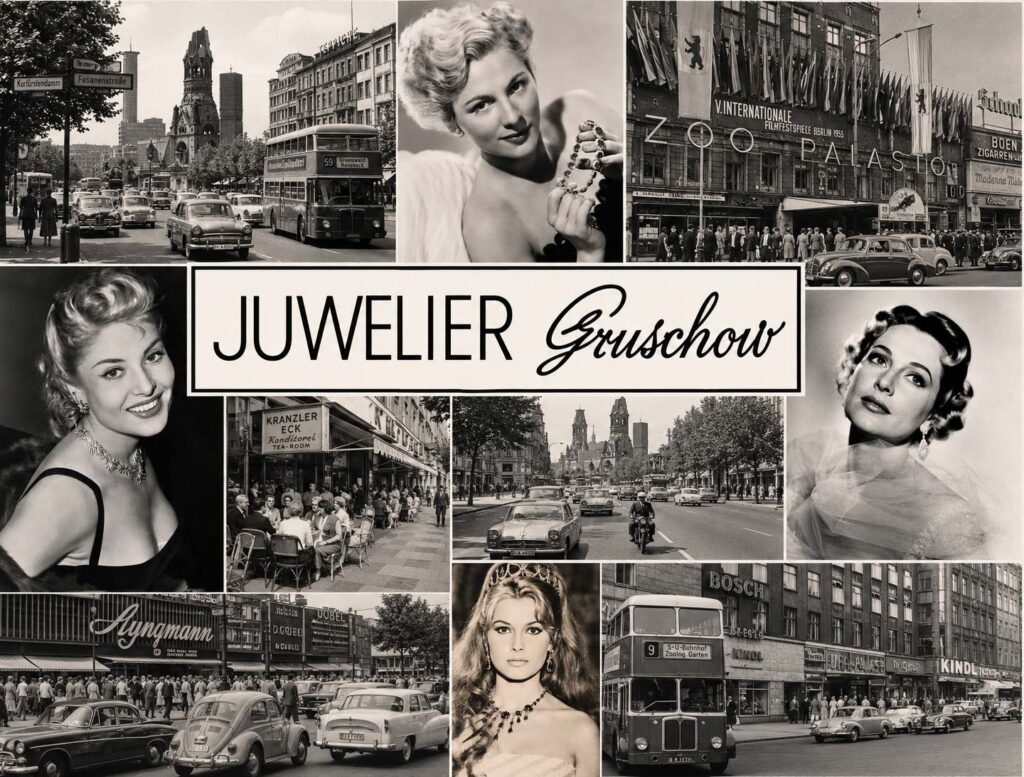
After World War II, Kurfürstendamm became the centre of the new West Berlin. While the historic centre of Berlin’s jewellery trade had been centred around Hausvogteiplatz, Friedrichstraße, and Leipziger Straße before 1945, the world of luxury now shifted to the western part of the city. Kurfürstendamm became a shopping street, a promenade, and a showcase for the Western way of life. It was on this street that Gruschow Jewellers eventually found its defining location: Kurfürstendamm 25, 10719 Berlin. The address was located in the eastern, particularly lively section of the boulevard—not far from the Gedächtniskirche, Joachimsthaler Straße, and numerous hotels, cafés, and fashion boutiques. Here, Gruschow offered an assortment that matched the classic image of an upscale jeweller: watches, jewellery, silverware, gemstones, and diamonds. Watch repairs were also part of the service.
Not an Anonymous Luxury Conglomerate
Gruschow was neither a company with international branches nor a conglomerate with interchangeable boutiques. Its strength likely lay instead in its personal connection to its clientele. In West Berlin in particular, owner-operated stores played an important role. Many customers purchased their engagement rings, wedding bands, anniversary gifts, or high-end watches from the same jeweller for decades. Such a purchase was based on trust. Customers wanted to know who had inspected the gemstone, who vouched for the authenticity of a piece of jewellery, and where they could turn in case of a repair. A preserved ruby-and-diamond necklace, complete with its case and a jewellery certificate from Gruschow, attests that the store also sold high-end jewellery and documented its quality in writing. The piece was later offered by an international auction house and fetched a high five-figure sum in Swiss francs. Gruschow was thus far more than just a small watch shop. The firm demonstrably also dealt in significant, valuable jewellery.
A Family Carries On the Business
In the early 2000s, another name appeared alongside Leo Gruschow: Marcel Gruschow. In 2002, the Berlin-based Tagesspiegel explicitly referred to him as the junior manager of the Gruschow jewellery store. A year later, he was again mentioned as a jeweller. A professional profile also lists him as the owner and managing director of the business. This demonstrates that the business has been carried on through at least three presumed generations:
- Emil Gruschow was synonymous with the postwar Berlin watch trade and his own brand, Amberte.
- Leo Gruschow became the namesake and defining jeweller of the store on Kurfürstendamm.
- Marcel Gruschow later emerged as the junior partner, owner, and managing director.
This succession effectively makes the Gruschow’s a Berlin family of jewellers—even though their documented corporate history apparently did not begin during the German Empire, but rather in postwar Berlin.
Between customers and the hustle and bustle of Ku’damm
The few press reports in which Gruschow appears paint a vivid picture of everyday business life on Kurfürstendamm. During the big street festivals, the boulevard regularly transformed into a bustling corridor of events. Thousands of people streamed across the street, weaving through vendor stalls, food stands, and stages. For many long-established retailers, however, this hustle and bustle was by no means a business advantage. In 2002, as junior manager, Marcel Gruschow complained that the so-called “food mile” tended to deter the store’s actual regular clientele. In 2003, he again voiced criticism of the event and its fair-like atmosphere. These statements are more than just casual newspaper quotes. They highlight the conflict that many owner-operated stores on Kurfürstendamm had to contend with: while the boulevard attracted huge crowds, not every visitor was also a customer of these long-established speciality shops. Gruschow relied less on quick walk-in sales than on loyal customers who came specifically for an personalized advice.
When Kurfürstendamm Lay in Ruins
The political history of West Berlin also unfolded right in front of Gruschow’s store windows. On April 12, 1981, serious riots broke out around Kurfürstendamm. The riots centred around squatter rights. 200 store windows were smashed, shops were damaged, and parts of the boulevard were devastated. A later report from that day mentioned Dorothea Bartosch, managing director of Gruschow Jewellers at Kurfürstendamm 25. It places her personal recollection of the day in the context of the riots that turned the boulevard into a landscape of rubble. For a jeweller, such events posed a particular threat. Jewellery, watches, and gemstones were on display behind large storefront windows, while at the same time, significant security measures were necessary. Gruschow thus experienced not only the elegant years of Kurfürstendamm but also those moments when the boulevard became the scene of political unrest and social conflict.
From family jeweller to silent witness to history
For decades, the store at Kurfürstendamm 25 was listed under the name Leo Gruschow or Juwelier Gruschow. Its offerings included jewellery, watches, watch repairs, silverware, gems, and diamonds. Publicly available sources do not currently provide clear evidence of when the store finally closed or was continued in another form. Business directories may continue to list older company entries for a long time, which is why they alone should not be used to conclude that the business is currently operating. What is certain, however, is that Gruschow was part of the established retail scene on Kurfürstendamm for many decades. The store witnessed the rise of West Berlin, the years of the economic miracle, the social upheavals of the 1960s through the 1980s, the fall of the Berlin Wall, and finally the transformation of Kurfürstendamm into a luxury shopping district increasingly dominated by international brands.
What Sets Gruschow Apart from Sedlatzek
Sedlatzek and Gruschow were both families of jewellers on Kurfürstendamm. Their histories, however, took fundamentally different paths. Sedlatzek’s roots stretched back to the 19th century. The firm had lived through the days of Berlin’s old jewellery district and embodied the connection between the German Empire, prewar Berlin, and West Berlin. Gruschow, on the other hand, seems to have been a child of the postwar era. The story began with Emil Gruschow’s watch business and the Amberte brand, registered in 1954. Leo Gruschow subsequently brought the name into the world of classic jewellery retail. With Marcel Gruschow, another generation finally stepped into the public eye. That is precisely what makes the family historically interesting. Gruschow did not stand for the splendour of the German Empire, but rather for reconstruction, the economic miracle, and the unique spirit of old West Berlin.
The Legacy of the Gruschow Family
So far, the history of the Gruschow family has been preserved only in scattered fragments: a watch brand from 1954, old wristwatches bearing the name Amberte, a store at Kurfürstendamm 25, a valuable piece of jewellery with a certificate, and a few newspaper articles about life on Berlin’s most famous boulevard. Taken together, however, these traces tell a remarkable family story. A postwar Berlin watch shop which evolved into a prestigious jewellery store with a personal style of retail that shaped Kurfürstendamm for decades. Today, international luxury brands dominate the street’s landscape. In contrast, the small and medium-sized family businesses that built up the boulevard after the war and gave it its distinctive character are increasingly falling into oblivion. Mrs Gruschow was still working in the shop and looking after her customers until the day she died.
Gruschow Jewellers was one of these businesses. Its story is neither that of a royal court jeweller nor that of a global jewellery conglomerate. It is the story of a family that made a fresh start in postwar Berlin, made a name for itself with watches and jewellery, and thrived on Kurfürstendamm for decades.
For this very reason, Gruschow deserves a place in the history of Berlin’s nearly forgotten jewellers.
Das könnte Ihnen auch gefallen
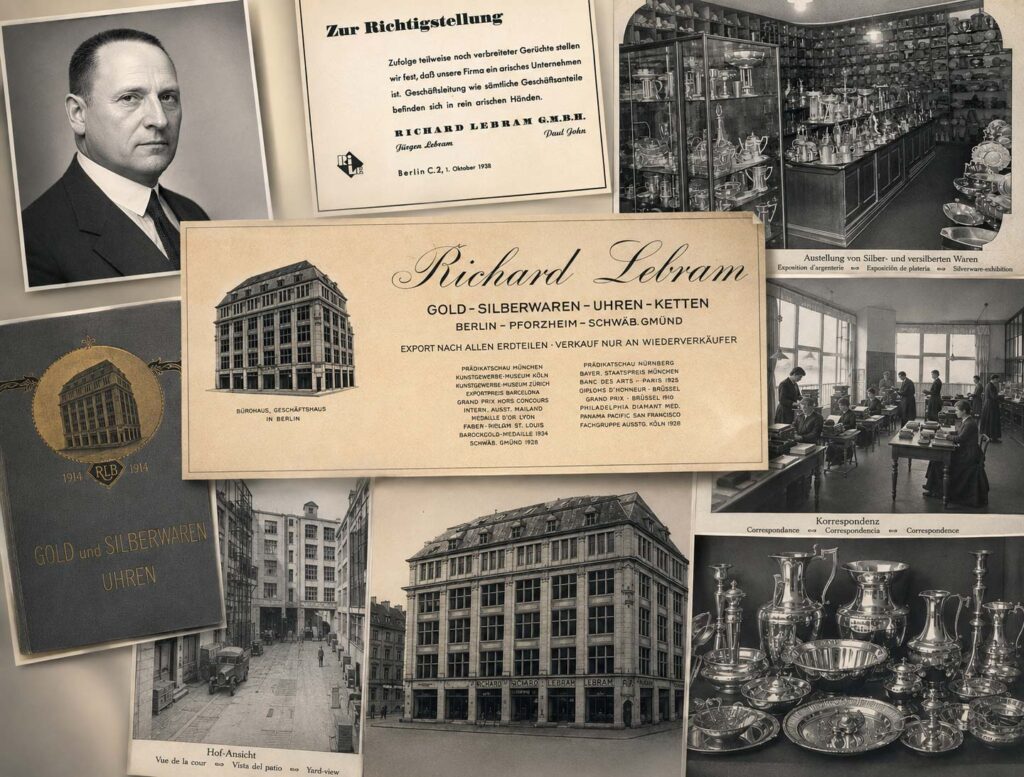
Richard Lebram is one of the most significant figures in Berlin’s jewellery history, yet he is virtually forgotten today. While names such as the Friedländer Brothers or WILH. MÜLLER are still occasionally mentioned, Richard Lebram himself has largely fallen into obscurity, even among collectors of historical jewellery. Yet at the beginning of the 20th century, […]

Our shop in Berlin-Mitte is located in the so-called Scheunenviertel (barn area). The history of this neighborhood is mostly tragic, marked by bitter poverty and great suffering of its inhabitants. The district got its name from the big hay barns, which were built in the 17th century for reasons of fire safety outside the Berlin […]
Dear Customers, your team from Rheinfrank – Antique Jewellery wishes you all a happy and healthy new year! Together we hope for an exciting as well as harmonious year with perfectly set highlights – and if possible, many of them! We for our part in the last year we have looked very closely and listened […]

If we assume the classic case of the man proposing to the woman and conjuring an engagement ring out of his trouser pocket, it seems clear to everyone that the ring is intended for the woman and that the next step is to put it on her finger. But is that always the case? When […]

Welcome to Rheinfrank – Antique Jewellery, your leading antique jewellery dealer in Munich. For over 21,000 years, the history of engagement rings has accompanied the love and bond between people. We specialise in engagement rings from the last 3 centuries, which inspire with their individual craftsmanship and unique designs. Here you will find handmade, […]

Welcome to the fascinating world of old jewelry! In the newly furnished shop of RHEINFRANK – Antique Jewellery you can buy antique jewelry from 3 centuries in a very relaxed atmosphere and let yourself be completely inspired. You can also view and purchase a representative and exciting part of our range in the large RHEINFRANK […]