

Richard Lebram Berlin – The Story of the Forgotten Berlin Jeweller and Jewellery Wholesaler
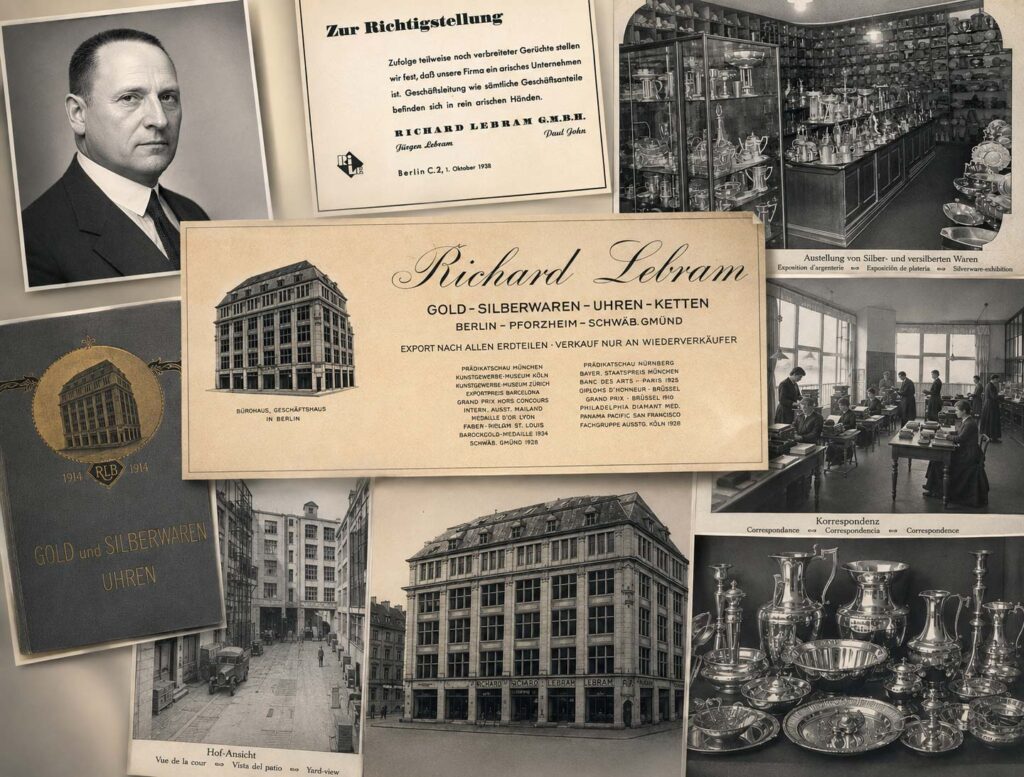
Richard Lebram is one of the most significant figures in Berlin’s jewellery history, yet he is virtually forgotten today. While names such as the Friedländer Brothers or WILH. MÜLLER are still occasionally mentioned, Richard Lebram himself has largely fallen into obscurity, even among collectors of historical jewellery. Yet at the beginning of the 20th century, his company was one of Germany’s largest jewellery and precious metals wholesalers and helped make Berlin one of Europe’s most important trading centres for jewels, gold jewellery, and silverware.
His prestigious commercial building at Wallstraße 15/15a in Berlin-Mitte was far more than just a corporate headquarters. It symbolized the economic rise of the German jewellery industry and Berlin’s international reputation as a hub for luxury goods, precious metals, and high-quality jewellery.
Richard Lebram – From Berlin Merchant to International Jewellery Wholesaler
Richard Lebram was born in Berlin in 1866. After completing his schooling at the historic Gymnasium zum Grauen Kloster, he initially began an apprenticeship in banking. However, he recognized early on the enormous potential of trading in gold, silver and jewellery.
In 1893, he founded his own wholesale business for gold and silver goods, costume jewellery and watches on Scharrenstraße in Berlin. At that time, Berlin was at the height of its economic growth. Within a few years, Lebram’s company had developed into one of the leading jewellery wholesalers within the German Empire.
Shortly after its founding, the business premises had to be expanded several times. This steady growth ultimately led to the construction of an entirely new commercial building on Wallstraße.
The Famous Commercial Building on Wallstraße
With the completion of the new building in 1911, one of Berlin’s most modern commercial buildings was created. Designed by the architects Hoeniger & Sedelmeier, the property featured technical innovations that were far ahead of their time: Passenger and freight elevators, an in-house pneumatic tube system, central heating, and a modern telephone system made the building a showcase for Berlin’s business community.
To this day, the historic landmark remains one of the most impressive surviving commercial buildings from Berlin’s Gründerzeit era and serves as a reminder of the heyday of Berlin’s jewellery trade.
Berlin as the World Capital of the Jewellery Trade
From his company headquarters in Berlin, Richard Lebram supplied jewellers, goldsmiths, watchmakers, and specialty retailers throughout the German Empire, as well as numerous international customers.
The company maintained branches in Pforzheim and Schwäbisch Gmünd, the two most important centres of German jewellery manufacturing. Sales catalogues were published in German, English, French, and Spanish – impressive evidence of the company’s international significance.
Richard Lebram thus played a decisive role at the turn of the 20th century for making Berlin one of Europe’s most important commercial hubs for jewellery, precious metals, and luxury goods.
An Entrepreneur with a Sense of Social Responsibility
Richard Lebram was not only a successful businessman but also an exceptionally progressive employer.
As early as the beginning of the 20th century, he set up a company cafeteria, washrooms, and changing rooms for his employees, as well as a company welfare fund – benefits that were anything but commonplace at the time.
In addition, he was active in numerous professional associations in the jewellery and watch industry and was one of the co-founders of the German Watch Trade Association.
The Company During the Nazi Era
In 1919, Richard Lebram and his wife, Nanny Heymann, adopted Jürgen Glaser and his sister, who from then on took the surname Lebram.
After Richard Lebram’s death in 1938, Jürgen Lebram continued to run the company. During the Nazi era, the company – like many other Berlin-based businesses – had to overcome significant political and economic challenges.
In 1942, the company was renamed Lebram & John GmbH. After World War II, the company’s headquarters were moved to Pforzheim. The company remained there until 1974, and when it closed down one of the most historic firms in the German jewellery industry finally ceased operations.
https://objekte.jmberlin.de/gobject/jmb-obj-553002
Richard Lebram and His Legacy
Today, historical catalogues, advertisements, and the impressive building on Wallstraße serve as reminders of a company that once had a decisive influence on Berlin’s jewellery trade.
For collectors of antique jewellery, historians, and enthusiasts of Berlin’s goldsmithing tradition, Richard Lebram ranks among the most important figures in German jewellery history.
Together with companies such as Gebrüder Friedländer, WILH. MÜLLER, Paul Telge, A. Wertheim, C. F. Zimmermann, Hugo Oppenheim, and numerous other Berlin jewellers, Richard Lebram turned the capital into an international hub for jewellery, diamonds, and precious metals.
Anyone following in the footsteps of Berlin’s historic jewellers today cannot miss Wallstraße. Richard Lebram’s former store building remains one of the most impressive testaments to that era, when Berlin was among Europe’s leading jewellery capitals and Richard Lebram was one of its most successful entrepreneurs.
Das könnte Ihnen auch gefallen

Cufflinks are probably the most versatile pieces of jewellery available. Not only for men with style and good taste, but in every respect. An unmatched variety of the used materials, stylistic means and motives, as well as every conceivable form characterize this category. Anyone who searches cufflinks and finds with us antique and vintage cufflinks, […]

Striving for a sustainable model of life does not mean sacrificing pleasure and luxury. Despite all the problems in the world and systematic injustices, there are ways to make your personal contribution to better circumstances. We know best about jewellery and accessories for beautiful outfits. And if we only share our knowledge about it with […]
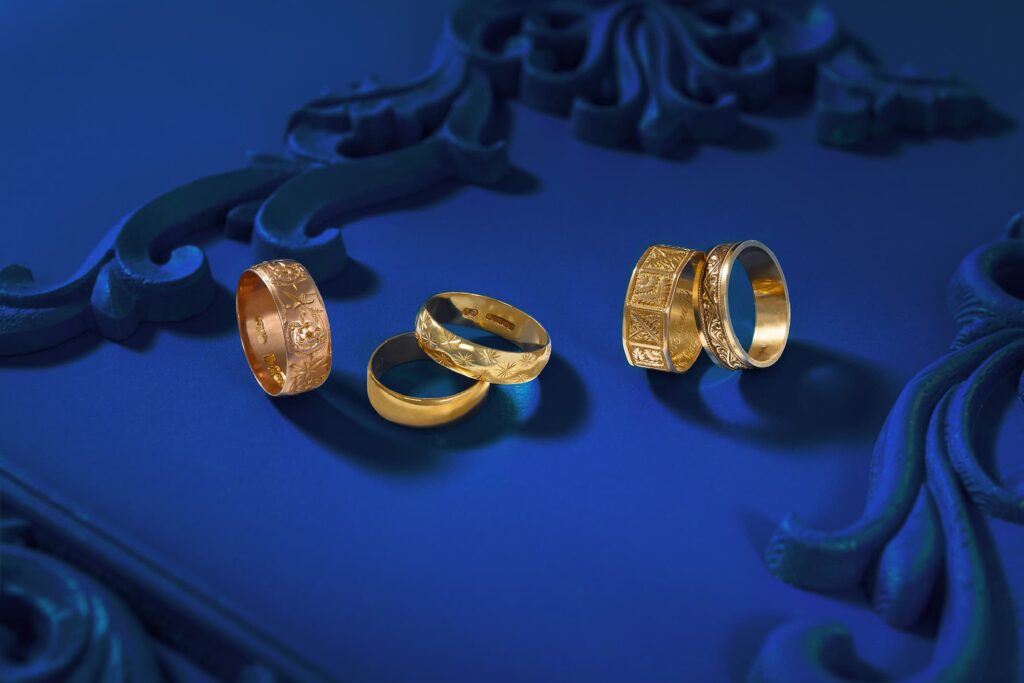
Since ancient times, the wedding ring has stood as a timeless symbol of love, unity, and eternity. In ancient Egypt, couples exchanged rings woven from reed or leather to mark their bond. The Romans were the first to craft rings from metal, representing strength and permanence. During the Middle Ages and the Renaissance, intricately engraved […]

The element water stands for life. His longing images in bright blue inspire our senses and awaken desires. Blue also stands for eternity and loyalty. So what a perfect color in antique jewelry! The birthstone and lucky stone of the month of March is breathtaking. Sea and sky blue shines the aquamarine – spring-like and […]

For sure, you know exactly who is the right one! But when it comes to the question of which hand is now the right one for the engagement ring, some stumble for good reason. Below we explain at what point the engagement ring adorns which hand. Wearing an Engagement Ring on the Right or Left […]

Oliver Rheinfrank on passion, friendships with dealers and the search for exceptional antique jewellery When I started building up Rheinfrank & Holzfuss together with Dirk Holzfuss 20 years ago, no one really believed in Dirk’s vision of an international antique jewellery company. To be honest, neither did I. At the time, I was working in […]